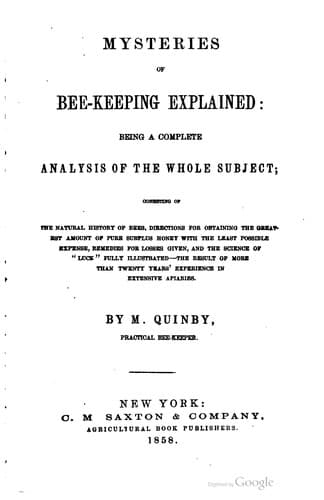
Mysteries of Bee-keeping ExplainedQuinby, M. (Moses)
Science
Mysteries of Bee-keeping Explained
Quinby, M. (Moses)
Bees
Suppose a quart of bees were put in a box or hive where all the cells
were filled and lengthened out with honey; the spaces between the combs
would be about one-fourth of an inch--only room for one thickness of
bees to spread through. The combs would perhaps be one and a half or
two inches thick. All the warmth that could be generated then, would be
by one course or layer of bees, an inch and a half apart. Although
every bee would have food in abundance without changing its position,
the first turn of severe weather would probably destroy the whole.
This, it may be said, "is an unnatural situation." I will admit that it
is; the case was only supposed for illustration. I know that their
winter quarters are among the brood combs, where the hatching of the
brood leaves most of the cells empty; and the space between the combs
is half an inch; a wise and beautiful arrangement; as ten times the
number of bees can pack themselves within a circle of six inches, as
can in the other case; and in consequence the same number of bees can
secure much more animal heat, and endure the cold much better; but a
_small_ family, even here, will often be found frozen, as well as
starving.
FROST AND ICE SOMETIMES SMOTHER BEES.
Besides freezing, there are other facts to be observed in stocks which
stand in the cold. If we examine the interior of a hive containing a
medium-sized swarm, on the first severely cold morning, except in the
immediate vicinity of the bees, we shall find the combs and sides of
the hive covered with a white frost. In the middle of the day, or as
soon as the temperature is slightly raised, this begins to melt,--first
next to the bees, then at the sides. A succession of cold nights will
prevent the evaporation of this moisture; and this process of freezing
and thawing, at the end of a week or two, will form icicles sometimes
as large as a man's finger, attached to the combs and the sides of the
hive. When the bottom of the hive is close to the floor, it forms a
sealing around the edges, perfectly air-tight, and your bees are
smothered. I have frequently heard bee-keepers say in these cases, "The
storm blew in, and formed ice all round the bottom, and froze my bees
to death." Others that have had their bees in a cold room, finding them
thus, "could not see how the water and ice could get there any way;
were quite sure it was not there when carried in," &c. Probably they
never dreamed of its being accounted for philosophically, and to
analyze anything pertaining to bees would be rather small business. But
what way can it be accounted for?
FROST AND ICE IN A HIVE ACCOUNTED FOR.
Public-domain text, read in full here on John Shaqi.
Reviews
Reviews
No reviews yet
Be the first to share your thoughts on this work.
Elsewhere in the archive
Join the Discussion
Join the discussion
Sign in to leave a comment or review.
Sign InorCreate an account