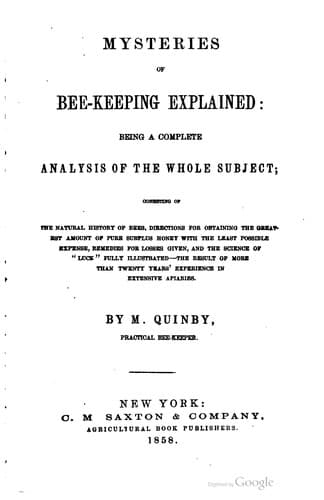
Mysteries of Bee-keeping ExplainedQuinby, M. (Moses)
Science
Mysteries of Bee-keeping Explained
Quinby, M. (Moses)
Bees
APPEARANCE OF BEES IN COLD WEATHER.
We will first endeavor to examine the condition of a stock left to
nature, without any care, and see if it affords any hints for our
guidance, when to assist and protect with artificial means.
Warmth being the first requisite, a family of bees at the approach of
cold weather crowd together in a globular form, into a compass
corresponding to the degree of cold; when at zero it is much less than
at thirty above. Those on the outside of this cluster are somewhat
stiffened with cold; while those inside are as brisk and lively as in
summer. In severe weather every possible space within their circle is
occupied; even each cell not containing pollen or honey will hold a
bee. Suppose this cluster is sufficiently compact for mutual warmth,
with the mercury at 40, and a sudden change brings it down to zero, in
a few hours, this body of bees, like most other things, speedily
contracts by the cold. The bees on the outside, being already chilled,
a portion of them that does not keep up with the shrinking mass, is
left exposed at a distance from their fellows, and receive but little
benefit of the warmth generated there; they part with their vitality,
and are lost.
HOW PART OF THE SWARM IS FROZEN.
A good family will form a ball or circle about eight inches in
diameter, generally about equal every way, and must occupy the spaces
between four or five combs. As combs must separate them into divisions,
the two outer ones are smallest, and most exposed of any; these are
often found frozen to death in severe weather. Should evidence be
wanting from other sources to show that bees will freeze to death, the
above would seem to furnish it. It is said, "that in Poland bees are
wintered in a semi-torpid state, in consequence of the extreme cold."
We must either doubt the correctness of this relation, or suppose the
bee of that country a different insect from ours--a kind of semi-wasp,
that will live through the winter, and eat little or nothing. The
reader can have no difficulty in deciding which is the most probable,
whether _bees are bees_ throughout the world, endowed with the same
faculties and instincts, or that the facts as they are, are not
precisely given, especially when we see what our own apiarians tell us
about their never freezing.
Here I might use strong language in contradiction; but as I am aware
that such a course is not always the most convincing, I prefer the test
of close observation. If bees will freeze, it is important to know it,
and in what circumstances.
HOW A SMALL FAMILY MAY ALL FREEZE.
Public-domain text, read in full here on John Shaqi.
Reviews
Reviews
No reviews yet
Be the first to share your thoughts on this work.
Elsewhere in the archive
Join the Discussion
Join the discussion
Sign in to leave a comment or review.
Sign InorCreate an account