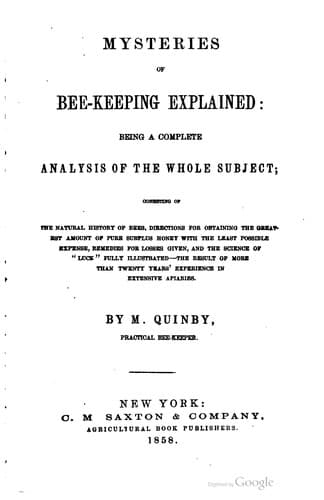
Mysteries of Bee-keeping ExplainedQuinby, M. (Moses)
Science
Mysteries of Bee-keeping Explained
Quinby, M. (Moses)
Bees
There is not sufficient animal heat generated to exhale the aqueous
portion of their food. The philosophy that explains why a man in warm
blood and in profuse perspiration would throw off or exhale more
moisture than in a quiet state, will illustrate this. The bees in these
circumstances must retain the water with the excrementitious part,
which soon distends their bodies to the utmost, rendering them unable
to endure it long. Their cleanly habits, that ordinarily save the combs
from being soiled, is not a sure protection now, and they are compelled
to leave the mass very often in the severest weather, to expel this
unnatural accumulation of fæces. It is frequently discharged even
before leaving the comb, but most of it at the entrance; also some
scattered on the front side of the hive, and a short distance from it.
In a moderately warm day, more bees will issue from a hive in this
condition than from others; it appears that a part of them are unable
to discharge their burden--their weight prevents their flying--they get
down and are lost. When cold weather is too long continued, they cannot
wait for warm days to leave, but continue to come out at any time; and
not one of such can then return. The cluster inside the hive is thus
reduced in numbers till they are unable to generate heat sufficient to
keep from freezing. With the indications attendant upon such losses, my
own observation has made me somewhat familiar, as the following
conversation will illustrate.
FURTHER ILLUSTRATIONS.
A neighbor who wished to purchase some stock hives in the fall,
requested my assistance in selecting them. We applied to a perfect
stranger; his bees had passed the previous winter in the open air. I
found on looking among them that he had lost some of them from this
cause, as the excrement was yet about the entrance of one old
weather-beaten hive, that was now occupied by a young swarm, and was
about half filled with combs.
I saw at once what had been the matter, and felt quite confident that I
could give its owner a correct history of it. "Sir," said I, "you have
been unfortunate with the bees that were in this hive last winter; I
think I can give you some particulars respecting it."
"Ah, what makes you think so? I would like to hear you guess; to
encourage you, I will admit that there has been something rather
peculiar about it."
Public-domain text, read in full here on John Shaqi.
Reviews
Reviews
No reviews yet
Be the first to share your thoughts on this work.
Elsewhere in the archive
Join the Discussion
Join the discussion
Sign in to leave a comment or review.
Sign InorCreate an account