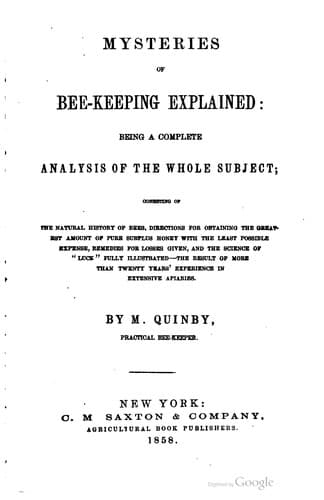
Mysteries of Bee-keeping ExplainedQuinby, M. (Moses)
Science
Mysteries of Bee-keeping Explained
Quinby, M. (Moses)
Bees
"One year ago you considered that a good stock-hive; it was well filled
with honey, a good family of bees, and two or three years old or more.
You had as much confidence in its wintering as any other; but during
the cold weather, somehow, the bees unaccountably disappeared, leaving
but a very few, and they were found frozen to death. You discovered it
towards spring, on a warm day. When you removed the combs, you probably
noticed a great many spots of excrement deposited on them, as well as
on the sides of the hive, particularly near the entrance. Also one-half
or more of the breeding cells contained dead brood, in a putrid state;
and this summer you have used the old hive for a new swarm."
"You are right, sir, in every particular. Now, I would like to know
what gave you the idea of my losing the bees in that hive? I can see
nothing peculiar about that old hive, more than this one," pointing to
another that also contained a new swarm. "You will greatly oblige me if
you will point out the signs particularly."
"I will do so with pleasure" (feeling quite willing to give him the
impression that I was "posted up" on this subject, notwithstanding it
savored strongly of boasting).
I then directed his attention to the entrance in the side of the hive,
where the bees had discharged their fæces, on the moment they issued,
until it was near the eighth of an inch thick, and two or three inches
broad; that yet remained, and just began to cleave off. "You see this
brown substance around this hole in the hive?"
"Yes, it is bee-glue (_propolis_); it is very common on old hives."
"I think not; if you will examine it closely, you will perceive it is
not so hard and bright; it already begins to crumble; bee-glue is not
affected by the weather for years."
"Just so, but what is it, and what has that to do with your
guess-work?"
"It is the excrement of the bees. In consequence of a great many cells
containing dead brood, which the bees could not enter, they were unable
to pack themselves close enough to secure sufficient animal heat to
exhale or drive off the water in their food, it was therefore retained
in their bodies till they were distended beyond endurance--they were
unable to wait for a warm day--necessity compelled them to issue daily
during the coldest weather, discharging their fæces the moment of
passing the entrance, and part of them before. They were immediately
chilled, and could not return; the quantity left about this entrance
shows that a great many must have come out. That they came out in cold
weather is proved by its being left on the hive, because in warm
weather they _leave_ the hive for this purpose."
"This is a new idea; at present it seems to be correct; I will think it
over. But how did you know that it was not a new swarm; that it was
well filled?"
Public-domain text, read in full here on John Shaqi.
Reviews
Reviews
No reviews yet
Be the first to share your thoughts on this work.
Elsewhere in the archive
Join the Discussion
Join the discussion
Sign in to leave a comment or review.
Sign InorCreate an account