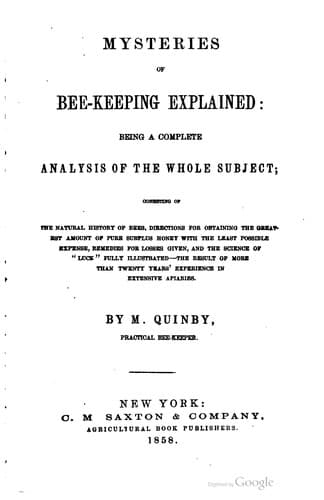
Mysteries of Bee-keeping ExplainedQuinby, M. (Moses)
Science
Mysteries of Bee-keeping Explained
Quinby, M. (Moses)
Bees
What does the American savage, who without difficulty can track the
panther or wolf, know of the principles of chemistry? What does the
Chemist know of following a track in the forest, when nothing but
withered leaves can guide him? Each understands principles, the
_minutiæ_ of which the other never dreamed.
IGNORANCE OF OFFICERS AND COMMITTEES.
Thus it appears to be with granting patents and premiums, if we take
what has been patented and praised by our committees and officers as
improvements in bee-culture. These men may be capable, intelligent, and
well fitted for their sphere, but in bee matters, about as capable of
judging, as the Hottentot would be of the merits of an intricate
steam-engine. Knowledge and experience are the only qualifications
competent to decide.
OPPOSITION TO SIMPLICITY.
I am aware that among the thousands whose direct interest is opposed to
my simple, plain manner of getting along, many will be ready to contend
with me for every departure from their patent, improved or premium
hives, as the case may be.
BY GAINING ONE POINT, PRODUCE ANOTHER EVIL.
I think it will be an easy matter to show that every departure from
simplicity to gain _one_ point, is attended in another by a
correspondent evil, that often exceeds the advantage gained. That we
have made vast improvements in art and science, and in every department
of human affairs, no one will deny; consequently, it is assumed we must
correspondingly improve in a bee-hive; forgetting that nature has fixed
limits to the instinct of the bee, beyond which she will not go!
It will be necessary to point out the advantages and objections to
these pretended improvements, and then we will see if we cannot avoid
the objections, _and retain the advantages, without the expense_, by a
simple addition to the common hive; because if we expect to encourage
bee-keeping, they must have better success than a neighbor of mine, who
expended fifty dollars for bees and a patent, and lost all in three
years! Most bee-keepers are farmers; very few are engineers sufficient
to work them successfully. I would say to all such as do not understand
the nature of bees, adhere to simplicity until you do, and then I am
quite sure you will have no desire for a change.
FIRST DELUSION.
Probably the first delusion in the patent line originated with the
idea, that to obtain surplus honey, it was absolutely necessary to have
a chamber hive. To get rid of the depredations of mice, the suspended
hive was contrived. The inclined bottom-board was then added to throw
out the worms. To prevent the combs from sliding down, the lower end
was contracted.
The principle of bees rearing queens from worker-eggs when destitute,
gave rise to the dividing hive in several forms. Comb, when used
several years, becomes thickened and black, and needs changing; hence
the changeable hives, Non-swarmers have been introduced to save risk
and trouble. Moth-proof hives to prevent the ravages of worms, &c., &c.
Public-domain text, read in full here on John Shaqi.
Reviews
Reviews
No reviews yet
Be the first to share your thoughts on this work.
Join the Discussion
Join the discussion
Sign in to leave a comment or review.
Sign InorCreate an account