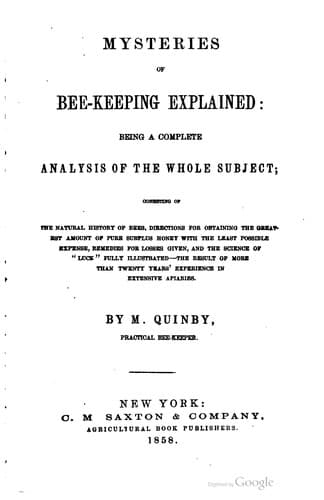
Mysteries of Bee-keeping ExplainedQuinby, M. (Moses)
Science
Mysteries of Bee-keeping Explained
Quinby, M. (Moses)
Bees
interest on the money that stocks cost is a mere trifle in comparison
to the value of increase, and you have the same trouble. On the other
hand, the owner of bees can afford to take care of a few hives more,
for half the profits, which he has to give if another takes them; this
is apt to be the case, especially, with such as have no faith in charms.
[21] There are sections of country where the difference in
seasons is less than in this.
RULE IN TAKING BEES FOR A SHARE.
The rule generally adopted for taking bees is this. One or more stocks
are taken for a term of years, the person taking them finding hives,
boxes, and bestowing whatsoever care is necessary, and returning the
old stocks to the owner with half the increase and profits.
A MAN MAY SELL HIS "LUCK."
There are yet a few persons who refuse to sell a stock of bees, because
it is "bad luck." There is often some grounds for this notion. It might
arise under the following circumstances. Suppose a person has a half
dozen hives, three extra good, the others of the opposite extreme. He
sells for the sake of the better price his three best; there is but
little doubt but his best "luck" would go too! But should his poorest
be taken, the result would be different, without doubt.
But there are cases where an apiarian has more stocks than he wishes to
keep. (It has been the case with myself frequently.) Persons wishing to
sell, are the proper ones of which to buy. Purchasers seldom want any
but first-rate stocks, they are generally cheapest in the end. There is
usually a difference of about a dollar in the spring and fall prices,
and five and six dollars are common charges. I have known them sell at
auction at eight, but in some sections they are less.
FIRST-RATE STOCKS RECOMMENDED TO BEGIN WITH.
For a beginning then, I would recommend purchasing none but first-rate
stocks; it will make but little difference in the risk, whether you
obtain them in the spring, or fall, if you have read my remarks on
winter management with attention; I have already said the requisites
for a good stock for winter, were a numerous family and plenty of
honey, and that the cluster of bees should extend through nearly all
the combs, &c. To avoid as far as possible diseased brood, find an
apiary where it has never made its appearance, to make purchases. There
are some who have lost bees by it, and yet are totally ignorant of the
cause. It would be well, therefore, to inquire if any stocks have been
lost, and then for the cause--be careful that secondary are not
mistaken for primary causes.
OLD STOCKS ARE GOOD AS ANY, IF HEALTHY.
Public-domain text, read in full here on John Shaqi.
Reviews
Reviews
No reviews yet
Be the first to share your thoughts on this work.
Elsewhere in the archive
Join the Discussion
Join the discussion
Sign in to leave a comment or review.
Sign InorCreate an account