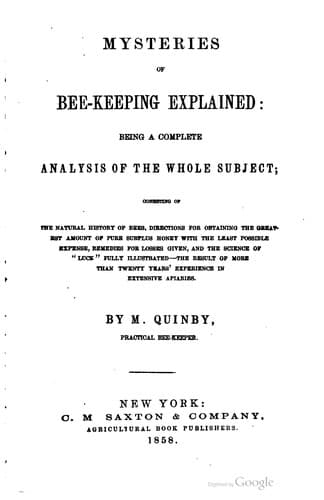
Mysteries of Bee-keeping ExplainedQuinby, M. (Moses)
Science
Mysteries of Bee-keeping Explained
Quinby, M. (Moses)
Bees
When it appears that all are exempt, (by a thorough examination, if not
satisfied without,) you need not object to stocks two or three years
old; they are just as good as any, sometimes better, (providing they
have swarmed the season previous, according to one author; because such
always have young queens, which are more prolific than old ones, that
will be in all first swarms).
Old stocks are as prosperous as any, as long as they are healthy, yet
they are more liable to become diseased.
CAUTION RESPECTING DISEASED BROOD.
When no apiary from which to purchase can be found, but where the
disease _has made_ its appearance, and you are necessitated to purchase
from such, or not at all, you cannot be too cautious about it. It would
be safest in this case to take none but young swarms, as it is not so
common for them to be affected the first season, yet they are not
always exempt. But here, again, you may not be allowed to take all
young stocks; in which case let the weather be pretty cold, the bees
will be further up among the combs, and give a chance to inspect the
combs. At this season, say not earlier than November, all the healthy
brood will be hatched. Sometimes, a few young bees may be left that
have their mature shape, and probably had been chilled by sudden cold
weather--these are not the result of disease, the bees will remove them
the next season, and no bad results follow. In warm weather a
satisfactory inspection can be had no other way, but by the use of
tobacco smoke. Be particular to reject all that are affected with the
disease in the least; better do without, than take such to begin with.
(A full description has been given of this disease in another place.)
RESULT OF IGNORANCE IN PURCHASING.
A neighbor purchased thirteen stock-hives; six were old ones, the
others swarms of the last season. As the old hives were heavy, he of
course thought them good; either he knew nothing of the disease, or
took no trouble to examine; five of the six old ones were badly
affected. Four were lost outright, except the honey; the fifth lasted
through the winter, and then had to be transferred. He had flattered
himself that they were obtained very cheaply, but when he made out what
his good ones cost, he found no great reason, in this respect, for
congratulation.
SIZES OF HIVES IMPORTANT.
Another point is worthy of consideration: endeavor to get hives as near
the right size as possible, _viz._, 2,000 cubic inches; better too
large than too small. If too large, they may be cut off, leaving them
the proper size. But yet, it often makes an ungainly shape, being too
large square for the height. As the shape probably makes no difference
in the prosperity of the bees, the appearance is the principal
objection, after being cut off.
Public-domain text, read in full here on John Shaqi.
Reviews
Reviews
No reviews yet
Be the first to share your thoughts on this work.
Elsewhere in the archive
Join the Discussion
Join the discussion
Sign in to leave a comment or review.
Sign InorCreate an account