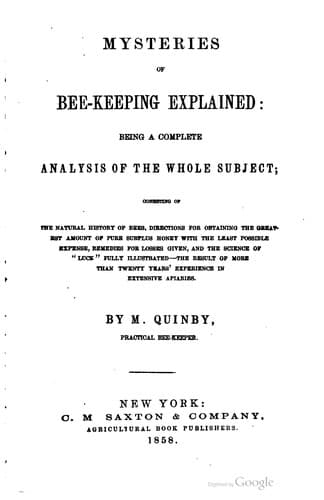
Mysteries of Bee-keeping ExplainedQuinby, M. (Moses)
Science
Mysteries of Bee-keeping Explained
Quinby, M. (Moses)
Bees
Here I will endeavor to be brief; I feel anxious to get through with
this disagreeable part, where every word I say will clash with
somebody's interest or prejudice. The merits of this hive are to obtain
surplus honey with but little trouble, which often succeeds in
satisfying people of its utility. The principal objection is found on
the score of profit. Suppose we start with one, call it worth five
dollars in the beginning, at the end of ten years it is worth no more,
very likely not as much, (the chances of its failing, short of that
time, we will not take into the account;) we might get annually, say
five dollars worth of surplus honey, amounting to fifty dollars.
CONTRAST OF PROFIT.
The swarming hive, we suppose, will throw off one swarm annually, and
make us one dollar's worth of surplus honey, (we will not reckon that
yielded by the first swarm, which is often more than that from the old
stocks,) about one third of the average in good seasons. The second
year there will be two to do the same; take this rate for ten years, we
have 512 stocks, either of them worth as much as the non-swarmer, and
about a thousand dollars worth of surplus honey. Call these stocks
worth five dollars each, which makes $2,560, all added together will
make the snug little sum of about $3,500, against $55. It is not to be
expected that any of us will realize profits to this extent, but it is
a forcible illustration of the advantages of the swarming hive over the
non-swarmer.
PRINCIPLE OF SWARMING NOT UNDERSTOOD.
But many of these non-swarmers, 'tis said, can be changed to swarmers
to suit the convenience of the apiarian--Colton's is one. It is
asserted that it can be made to swarm within two days at any time,
merely by taking off the six boxes or drawers that are very ingeniously
attached; as this contracts the room, the bees are forced out. Now I
will candidly confess that I could never get this thing to work at all.
Of this I am quite positive, that he (Mr. Colton) is either ignorant of
the necessary and regular preparations that bees make before swarming,
or supposes others are. Mr. Weeks has advocated the same principle: he
says, "There is no queen in any stage of existence, in the old stock,
immediately after the first swarm leaves it." I have examined this
matter till I am satisfied I risk but little in the bold assertion,
that not one stock in fifty will cast a swarm short of a week after
commencing preparations. This opinion will be adopted by whoever will
take the trouble to investigate for themselves. (The chapter on
swarming will give the necessary instructions for examining this point,
if you wish.)
NOT TO BE DEPENDED UPON.
Further, these non-swarmers are not always to be depended upon as such.
They will sometimes throw off swarms when there is abundant room in the
hive as well as in the boxes.
HIVES NOT ALWAYS FULL BEFORE SWARMING.
Public-domain text, read in full here on John Shaqi.
Reviews
Reviews
No reviews yet
Be the first to share your thoughts on this work.
Join the Discussion
Join the discussion
Sign in to leave a comment or review.
Sign InorCreate an account