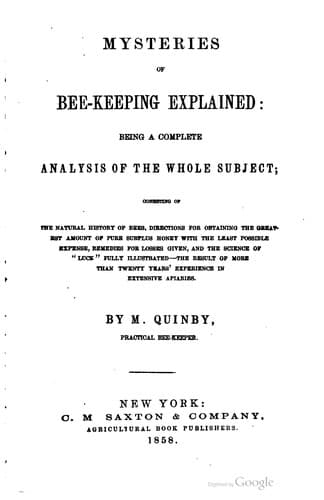
Mysteries of Bee-keeping ExplainedQuinby, M. (Moses)
Science
Mysteries of Bee-keeping Explained
Quinby, M. (Moses)
Bees
About the first of April they commence collecting pollen and rearing
their young; by the middle of May all good stocks will occupy nearly,
if not quite all, their brood-combs for that purpose, but _little honey
is obtained_ before fruit blossoms appear; when these are gone, no more
of any amount is obtained until clover appears, which is some ten days
later. (I am speaking now particularly of this section; I am aware it
is very different in other places, where different flowers exist.) Now
if this season of fruit flowers should be accompanied by high winds, or
cold rainy weather, but little honey is obtained; and our bees have a
numerous brood on hand that _must be fed_. In this emergency, if no
honey is on hand of the previous year, a famine ensues; they destroy
their drones, perhaps some of their brood, and for aught I know put the
old bees on short allowance. This I do know, that the whole family has
actually starved at this season; sometimes in small hives. This of
course depends on the season; when favorable, nothing of the kind
occurs. Prudence therefore dictates the necessity of a provision for
this emergency, by making the hive a little larger for northern
latitudes, as a little more honey will be stored to take them through
this critical period. From a series of experiments closely observed.
2,000 INCHES SAFE FOR THIS SECTION.
I am satisfied that 2,000 inches in the clear, is the proper size for
safety in this section, and consequently, profit. On an average, swarms
from this size are as large as any.
The dimensions should be uniform in all cases, whatever size is decided
on. It is folly to accommodate each swarm with a hive corresponding in
size; a very small family this year, may be very large next, and a very
large one, very small, &c. A queen belonging to a small swarm will be
capable of depositing as many eggs, as another belonging to a barrel
full. A small family able to get through the winter and spring, may be
expected by another year to be as numerous as any.
KIND OF WOOD, WIDTH OF BOARD, ETC.
Public-domain text, read in full here on John Shaqi.
Reviews
Reviews
No reviews yet
Be the first to share your thoughts on this work.
Join the Discussion
Join the discussion
Sign in to leave a comment or review.
Sign InorCreate an account