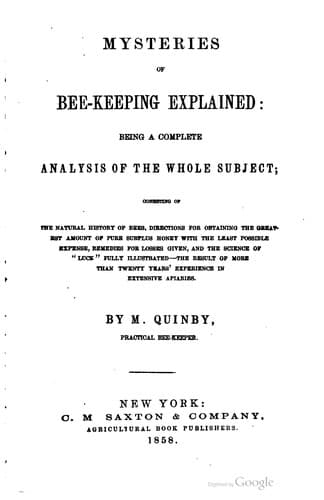
Mysteries of Bee-keeping ExplainedQuinby, M. (Moses)
Science
Mysteries of Bee-keeping Explained
Quinby, M. (Moses)
Bees
Substitute for Pollen, 88
Manner of packing it, 89
Alder yields the first, 89
Fruit Flowers important in good weather, 91
Red Raspberry a favorite, 91
Catnip, Mother-wort and Hoarhound, are sought after, 92
Singular fatality attendant on Silkweed, 93
Large yield from Basswood, 96
Garden Flowers unimportant, 97
Honey-dew, 97
Singular Secretion, 98
Secretions of the Aphis, 98
Advantages of Buckwheat, 101
Amount of honey collected from it, 101
Do Bees injure the crop? 102
Are not Bees an advantage to vegetation? 103
A test for the presence of Queen doubted, 106
An extra quantity of Pollen not always detrimental, 107
What combs are generally free from Bee-bread, 108
Manner of packing stores, 108
Philosophy in filling a cell with honey, 109
Long cells sometimes turned upward, 110
Is a dry or wet season best for honey? 111
How many Stocks should be kept, 112
Three principal sources of honey, 112
CHAPTER V.
WAX.
Is Pollen converted into Wax? 115
How is it obtained? 115
Huber's account of a commencement of comb, 117
Best time to witness comb-making, 118
Manner of working Wax, 119
Are crooked Combs a disadvantage? 120
Uncertainty in weight of Bees, 122
Some wax wasted, 124
Water necessary in Comb-making, 124
Remarks, 126
CHAPTER VI.
PROPOLIS.
What used for, 128
Is it an elaborate or natural substance? 129
Huber's Opinion, 129
Further Proof, 129
Remarks, 132
CHAPTER VII.
THE APIARY.
Public-domain text, read in full here on John Shaqi.
Reviews
Reviews
No reviews yet
Be the first to share your thoughts on this work.
Join the Discussion
Join the discussion
Sign in to leave a comment or review.
Sign InorCreate an account