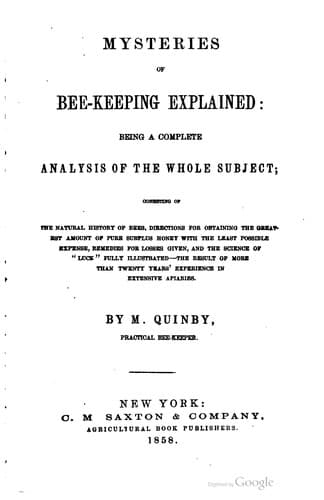
Mysteries of Bee-keeping ExplainedQuinby, M. (Moses)
Science
Mysteries of Bee-keeping Explained
Quinby, M. (Moses)
Bees
Some of you may have seen paraded at our fairs, or in the public parts
of some of our cities, hives containing tumblers, some of them neatly
filled, others empty, and this meagre sentence written upon them, _not
to be filled_! Pretending to govern the bees, as the juggler sometimes
does his tricks, by mysterious incantations! I once encountered an
agent of this humbug, and modestly suggested to him that I had a
counter charm: that I could put a tumbler on his hive and it would be
filled if the others were, however much he might forbid it by written
charms! He saw at a glance how the matter stood; I was not the customer
he wanted, and intimated that the show was only intended for the
extreme verdancy of most visitors. It no doubt assisted in displaying
his profound knowledge in bee management, which he wished to establish,
as he had a little work on the subject to sell, also hives, and bees.
The reader no doubt will guess as I did, the reason that those tumblers
were not filled, was because no combs were put in for a start.
PERFECT OBSERVATORY HIVE DESCRIBED.
There are many things pertaining to bees that cannot be properly
examined and understood, without a glass hive of some sort. Yet a
perfect observatory hive containing but one comb, is not a perfect hive
for the bees. We can see very well what the bees are doing, but it is
not a tenement they would choose if left to themselves. It forces them
to labor in an unnatural manner, is unsuitable for wintering bees, and
otherwise but little profit. If the satisfaction of witnessing some of
their operations more perfectly than in glass hives of another kind
will not pay, it is doubtful if we get it. I will describe as briefly
as possible. Two frames or sashes about two and a half feet square,
containing glass, are so fastened together as to leave room for only
one comb between them, about an inch and three-fourths apart. A comb of
this size will not support itself by the top and edges; hence, it is
necessary to put in numerous cross-bars to assist in supporting it.
Outside the glass are doors to keep the whole dark, to be opened when
we wish to inspect proceedings. Under the bottom is a board or frame,
to keep it in an upright position, &c. Probably but few will be induced
to make one. I will therefore describe another; a hive that I think
will pay better.
ONE LIKE COMMON HIVE PREFERRED.
If we expect to know what bees are doing in ordinary hives, we must
have one similar in every respect, in size, shape, number of bees, &c.
The construction of royal cells will be watched by most observers with
the greatest interest; now these are generally on one edge of the
combs. The bees leave a space half an inch or more between the edges of
the combs and one side of the hive, near half the length of it,
apparently for no other purpose but to have room for these cells, as
the other edges of the same combs are generally attached to the hive at
the bottom.
WHAT MAY BE SEEN.
Public-domain text, read in full here on John Shaqi.
Reviews
Reviews
No reviews yet
Be the first to share your thoughts on this work.
Join the Discussion
Join the discussion
Sign in to leave a comment or review.
Sign InorCreate an account