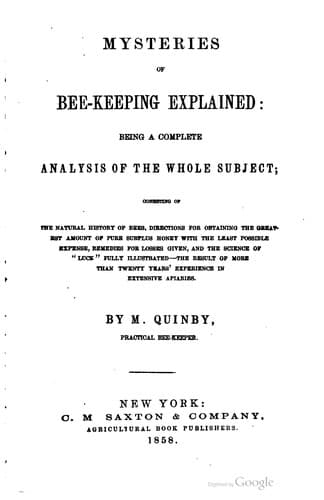
Mysteries of Bee-keeping ExplainedQuinby, M. (Moses)
Science
Mysteries of Bee-keeping Explained
Quinby, M. (Moses)
Bees
This substance is first used to solder up all the cracks, flaws, and
irregularities about the hive. A coat is then spread over the inside
throughout; when the hive is full, and many bees cluster outside, the
latter part of summer, a coat of it is also spread there. An additional
coat it seems is annually applied, as old hives will be coated with a
thickness proportionate to its age, providing it has been occupied with
a strong family. Huber has said it was also used to strengthen the
cells when first made, by mixing it with the wax. If it was their
practice at that time, the practice has been abandoned by our bees to a
great extent. I have made examinations when comb was first made, when
it contained eggs, and when it contained larvæ, and have never been
able to find anything other than pure wax composing it. After a young
bee has matured in a cell, the coating or cocoon that it leaves is of a
dark color, somewhat resembling it, and may have given rise to the
supposition. How the article is obtained, appears to be the mystery.
This is a subject about which apiarians have failed to agree. A few
contend that it is an elaborated substance; while others assert it to
be a resinous gum, exuding from certain trees, and collected by the
bees like pollen. It differs materially from wax, being more tenacious,
and when it gets a little age, much harder.
IS IT AN ELABORATE OR NATURAL SUBSTANCE?
No modern observer has ever been able to detect the bees in the act of
gathering it.
HUBER'S OPINION.
Huber tells us, that "near the outlet of one of his hives, he placed
some of the branches of the poplar, which exuded a transparent juice,
the color of garnet. Several workers were soon seen perched upon these
branches,--having detached some of this resinous gum, they formed it
into pellets, and deposited them in the baskets of their thighs; thus
loaded, they flew to the hive, where some of their fellow-laborers
instantly came to assist them in detaching this viscid substance from
their baskets." Some of our modern apiarians have doubted this account
of Huber's. Now, in the absence of anything positive on this subject, I
am inclined to adopt this theory; that it is a resin or gum produced by
trees. (I cannot say that I am exactly satisfied with the story of
bringing the "branches and laying them by the hive," &c.) That bees
gather it in its natural state, is in accordance with my own
observation.
FURTHER PROOF.
Public-domain text, read in full here on John Shaqi.
Reviews
Reviews
No reviews yet
Be the first to share your thoughts on this work.
Elsewhere in the archive
Join the Discussion
Join the discussion
Sign in to leave a comment or review.
Sign InorCreate an account