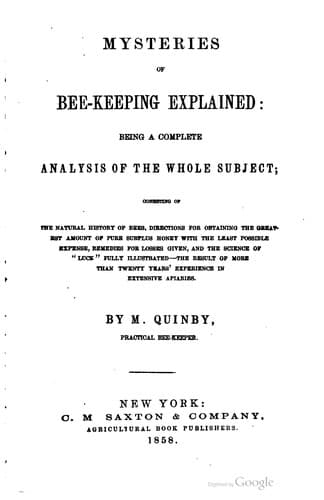
Mysteries of Bee-keeping ExplainedQuinby, M. (Moses)
Science
Mysteries of Bee-keeping Explained
Quinby, M. (Moses)
Bees
Our first swarms that issue in May, or first of June, seldom use much
of the article pure for soldering and plastering; but instead, a
composition, the most of which is wax. I have noticed at this season,
when old pieces of boards that had been used for hives, were left in
the sun, that this old propolis would become soft in the middle of the
day. Here I have frequently seen the bees at work, packing it upon
their legs; it was detached in small particles, and the process of
packing was seen distinctly, as the bee did not fly during the
operation, as in the case of packing pollen. It is asserted that when
bees need it they always have it, indicating that they can elaborate it
like wax. I can see no reason why they do not need it in June as much
as August; yet, in the latter month, they use more than a hundred times
the quantity. At this time, they manifest no disposition to gather any
from the old boards, &c. It would seem they prefer the article new,
which they now have in abundance. Boxes filled in June contain but very
little, sometimes none. Why not, if they have enough of it? but when
filled in August, they always have the corners, and sometimes the top
and sides, lined with a good coat. Cracks, large enough for bees to
pass through, are sometimes completely filled with it. In this season,
a little before sunset of some fair day, I have frequently seen the
bees enter the hive with what I supposed to be the pure article on
their legs, like pollen, except the surface, which would be smooth and
glossy; the color much lighter than when it gets age. I have also seen
them through the glass inside, when they seemed unable to dislodge it
themselves, like pollen, and were continually running around among
those engaged in soldering and plastering; when one required a little,
it seized hold of the pellet with its teeth or forceps, and detached a
portion. The whole lump will not cleave off at once; but firmly adheres
to the leg; from its tenacity, perhaps a string an inch long will be
formed in separating, the piece obtained is immediately applied to
their work, and the bee is ready to supply another with a portion; it
doubtless gets rid of its load in this way; it is difficult to watch it
till it is freed from the whole, as it is soon lost among its fellows.
Now if this substance is not found in its natural state, how does it
happen that they pack it on their legs just as they do when getting it
from a board of an old hive, or pollen, when collected? They never take
the trouble to pack the wax there, when elaborated. Do not these
circumstances strongly favor the idea of its being a vegetable
substance? Perhaps the reason of its being collected at this season in
greater abundance, may be found in the fact, that the buds of trees and
shrubs are now generally formed. Many kinds are protected from rain and
frost, by a kind of gum or resinous coating. It may be found in many
species of Populus, particularly the balsam poplar, (_Populus
Public-domain text, read in full here on John Shaqi.
Reviews
Reviews
No reviews yet
Be the first to share your thoughts on this work.
Elsewhere in the archive
Join the Discussion
Join the discussion
Sign in to leave a comment or review.
Sign InorCreate an account