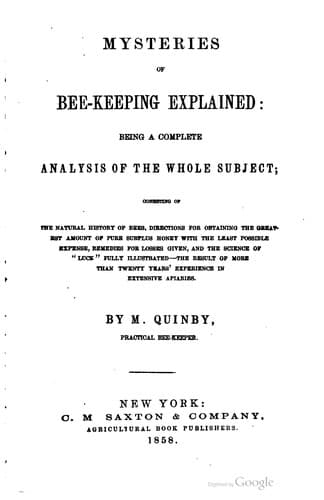
Mysteries of Bee-keeping ExplainedQuinby, M. (Moses)
Science
Mysteries of Bee-keeping Explained
Quinby, M. (Moses)
Bees
Balsamifera_) and the Balm of Gilead, (_Populus Candicans_). By boiling
the buds of these trees, an aromatic resin or gum may be obtained,
(used sometimes for making salve;) the odor is very similar to that
emitted by propolis, when first gathered by the bees, or by heating it
afterwards. In the absence of facts, we are apt to substitute theory.
This appears to me to be very plausible. Yet I am ready to yield it as
soon as facts decide differently. Perhaps not one bee in a thousand is
engaged in collecting this substance--there being so few may be one
reason why they are not often detected, yet few as they are, a few of
us should set about close observation; something certain might decide.
Apiarian science is sadly neglected; a large amount of error is mixed
up with truth, that patient, scrutinizing investigation must separate.
REMARKS.
I feel anxious to get to the practical part of this work, which I hope
will interest some readers who care but little about the natural
history. I shall begin with spring, and will now endeavor to mix more
of the practical with it, as we proceed to the end of the year. In
order to illustrate some points of practice, I may have occasion to
repeat some things already mentioned.
CHAPTER VII.
THE APIARY.
ITS LOCATION.
In the location of the apiary, one important consideration is, that it
is convenient to watch in the swarming season; that the bees may be
seen at any time from a door or window, when a swarm rises, without the
trouble of taking many steps to accomplish it; because if much trouble
is to be taken, it is too often neglected. Also, if possible, the hives
should stand where the wind will have but little effect, especially
from the northwest. If no hills or building offer a protection, a
close, high board fence should be put up for the purpose. It is economy
to do it--bees enough may be saved to pay the expense. During the first
spring months, the stocks contain fewer bees than at any other season.
It is then that a numerous family is important, for the purpose of
creating animal heat to rear the brood, if for nothing else. One bee is
of more consequence now than a half dozen in midsummer. When the hive
stands in a bleak place, the bees returning with heavy loads, in a high
wind, are frequently unable to strike the hive, and are blown to the
ground; become chilled, and die. A chilly south wind is equally fatal,
but not so frequent. When protected from winds, the hives may front any
point you choose; east or south is generally preferred. A location near
ponds, lakes, large rivers, &c., will be attended with some loss. Hard
winds will fatigue the bees when on the wing, often causing them to
alight in the water; where it is impossible to rise again until wafted
ashore, and then, unless in very warm weather, they are so chilled as
to be past the effort. I do not mention this to discourage any one from
keeping them, when so situated, because some few must keep them thus or
not at all.
Public-domain text, read in full here on John Shaqi.
Reviews
Reviews
No reviews yet
Be the first to share your thoughts on this work.
Elsewhere in the archive
Join the Discussion
Join the discussion
Sign in to leave a comment or review.
Sign InorCreate an account