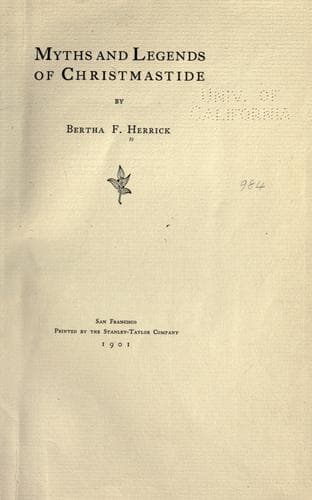
Myths and Legends of ChristmastideHerrick, Bertha F.
History
Myths and Legends of Christmastide
Herrick, Bertha F.
Christmas; Christmas -- History
In some of the villages in Wales a Christmas pudding is boiled for
each of the disciples, with the exception of Judas, and in the rural
districts of Scotland bread baked on Christmas Eve is said to
indefinitely retain its freshness.
"The Fatherland" is the home of the Christmas tree, which is thought
to be symbolical of the "Tree of the Knowledge of Good and Evil," in
the Garden of Eden; and candles were first used to typify the power of
Christianity over the darkness of paganism, being sometimes arranged
in triangular form to represent the Trinity.
Pines and firs being unattainable in the tropical islands of the
Pacific, the white residents sometimes cut down a fruit tree, such as
an orange or a guava, or actually manufacture a tree from wood,
covering the bare, stiff boughs with clinging vines of evergreen.
In the Holy Land at this season the place of greatest interest is
naturally the Church of the Nativity at Bethlehem, erected on the
supposed location where Christ was born. It is said to be the oldest
Christian church in existence, having been built more than fifteen
centuries ago by the Empress Helena, mother of Constantine. Repairs
were made later by Edward IV of England; but it is now again fast
falling into decay. The roof was originally composed of cedar of
Lebanon and the walls were studded with precious jewels, while
numerous lamps of silver and gold were suspended from the rafters. The
Greeks, Latins and Armenians now claim joint possession of the
structure, and jealously guard its sacred precincts. Immediately
beneath the nave of the cathedral is a commodious marble chamber,
constructed over the spot where the far-famed stable was said to have
stood and reached by a flight of stone steps, worn smooth by the tread
and kisses of multitudes of worshippers. The manger is represented by
a marble slab a couple of feet in height, decorated with tinsel and
blue satin and marked at the head with a chiseled star, bearing above
it the inscription in Latin, "Here was Jesus Christ born of the Virgin
Mary." At the foot are several altars, on which incense is ever kept
burning and from which mass is conducted, while a score of hanging
lamps shed a fitful light over the apartment.
Many theories have been advanced as to the explanation of the
mysterious "Star in the East" which guided the wondering shepherds,
but it is now thought to have been Venus at the height of its
splendor.
The early Christians decorated their churches with evergreens out of
respect to the passage of Scripture in Isaiah--"The glory of Lebanon
shall come unto thee; the fir tree, the pine tree and the box together
to beautify the place of my sanctuary"--and the pagans believed them
to be omens of good, as the spirits of the woods remained in their
branches.
Holly is known in Germany and Scandinavia as "Christ's thorn," and is
emblematic everywhere of cheerfulness, forgiveness, "peace on earth
and good will to men."
Public-domain text, read in full here on John Shaqi.
Reviews
Reviews
No reviews yet
Be the first to share your thoughts on this work.
Join the Discussion
Join the discussion
Sign in to leave a comment or review.
Sign InorCreate an account