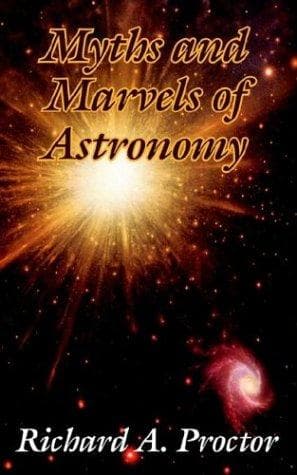
Myths and Marvels of AstronomyProctor, Richard A. (Richard Anthony)
History
Myths and Marvels of Astronomy
Proctor, Richard A. (Richard Anthony)
Astronomy
wind and calm, rain and drought, and so forth. Always, whether the sun
is very much spotted or quite free from spots, something unusual in the
way of weather must be going on somewhere, demonstrating in the most
significant way the influence of sun-spots or the want of sun-spots on
the weather. It is true that captious minds might say that this method
of reasoning proved too much in many ways, as, for example,
thus--always, whether the sun is very much spotted or quite free from
spots, some remarkable event, as a battle, massacre, domestic tragedy on
a large scale, or the like, may be going on, demonstrating in the most
significant way the influence of sun-spots or the want of sun-spots on
the passions of men--which sounds absurd. But the answer is twofold.
First, such reasoning is captious, and secondly, it is not certain that
sun-spots, or the want of them, may not influence human passions; it may
be worth while to enquire into this possible solar influence as well as
the other, which can be done by crossing the hands of the new
fortune-tellers with a sufficient amount of that precious metal which
astrologers have in all ages dedicated to the sun.
That the new system of divination is not solely solar, but partly
planetary also, is seen when we remember that the sun-spots wax and wane
in periods of time which are manifestly referable to the planetary
motions. Thus, the great solar spot-period lasts about eleven years, the
successive spotless epochs being separated on the average by about that
time; and so nearly does this period agree with the period of the planet
Jupiter's revolution around the sun, that during eight consecutive
spot-periods the spots were most numerous when Jupiter was farthest from
the sun, and it is only by going back to the periods preceding these
eight that we find a time when the reverse happened, the spots being
most numerous when Jupiter was nearest to the sun. So with various other
periods which the ingenuity of Messrs. De la Rue and Balfour Stewart has
detected, and which, under the closest scrutiny, exhibit almost exact
agreement for many successive periods, preceded and followed by almost
exact disagreement. Here, again, the captious may argue that such
alternate agreements and disagreements may be noted in every case where
two periods are not very unequal, whether there be any connection
between them or not; but much more frequently when there is no
connection: and that the only evidence really proving a connection
between planetary motions and the solar spots would be constant
agreement between solar spot periods and particular planetary periods.
But the progress of science, and especially the possible erection of a
new observatory for finding out ('for a consideration') how sun-spots
affect the weather, etc., ought not to be interfered with by captious
reasoners in this objectionable manner. Nor need any other answer be
given them. Seeing, then, that sun-spots manifestly affect the weather
Public-domain text, read in full here on John Shaqi.
Reviews
Reviews
No reviews yet
Be the first to share your thoughts on this work.
Join the Discussion
Join the discussion
Sign in to leave a comment or review.
Sign InorCreate an account