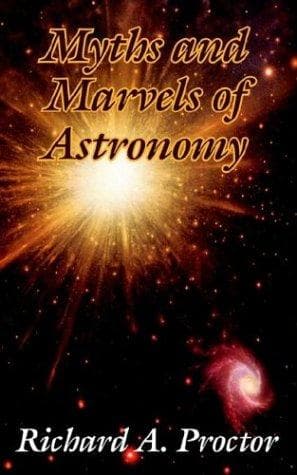
Myths and Marvels of AstronomyProctor, Richard A. (Richard Anthony)
History
Myths and Marvels of Astronomy
Proctor, Richard A. (Richard Anthony)
Astronomy
If we consider the reasoning now commonly thought valid in favour of the
doctrine that other orbs besides our earth are inhabited, and compare it
with the reasoning on which judicial astrology was based, we shall not
find much to choose between the two, so far as logical weight is
concerned. Because the only member of the solar system which we can
examine closely is inhabited, astronomers infer a certain degree of
probability for the belief that the other planets of the system are also
inhabited. And because the only sun we know much about is the centre of
a system of planets, astronomers infer that probably the stars, those
other suns which people space, are also the centres of systems; although
no telescope which man can make would show the members of a system like
ours, attending on even the nearest of all the stars. The astrologer had
a similar argument for his belief. The moon, as she circles around the
earth, exerts a manifest influence upon terrestrial matter--the tidal
wave rising and sinking synchronously with the movements of the moon,
and other consequences depending directly or indirectly upon her
revolution around the earth. The sun's influence is still more manifest;
and, though it may have required the genius of a Herschel or of a
Stephenson to perceive that almost every form of terrestrial energy is
derived from the sun, yet it must have been manifest from the very
earliest times that the greater light which rules the day rules the
seasons also, and, in ruling them, provides the annual supplies of
vegetable food, on which the very existence of men and animals depends.
If these two bodies, the sun and moon, are thus potent, must it not be
supposed, reasoned the astronomers of old, that the other celestial
bodies exert corresponding influences? _We_ know, but they did not know,
that the moon rules the tides effectually because she is near to us, and
that the sun is second only to the moon in tidal influence because of
his enormous mass and attractive energy. We know also that his position
as fire, light, and life of the earth and its inhabitants, is due
directly to the tremendous heat with which the whole of his mighty
frame is instinct. Not knowing this, the astronomers of old times had no
sufficient reason for distinguishing the sun and moon from the other
celestial bodies, so far at least as the general question of celestial
influences was concerned.
Public-domain text, read in full here on John Shaqi.
Reviews
Reviews
No reviews yet
Be the first to share your thoughts on this work.
Join the Discussion
Join the discussion
Sign in to leave a comment or review.
Sign InorCreate an account