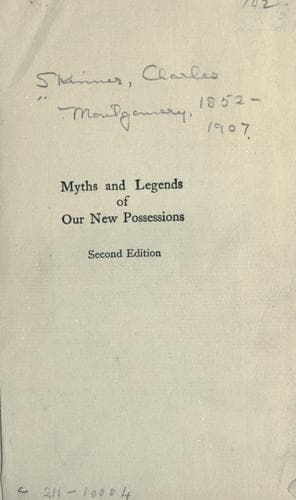
Myths & Legends of our New Possessions & ProtectorateSkinner, Charles M. (Charles Montgomery)
History
Myths & Legends of our New Possessions & Protectorate
Skinner, Charles M. (Charles Montgomery)
Tales -- Oceania; Tales -- West Indies
This announcement carried joy to the heart of the questioner, and he
began at once the erection of an altar, the aged priest sprinkling
it with blessed water and placing beside it the phallic symbol of the
trinity. The invocation was over, but no living creature appeared in
the desert to serve as a sacrifice. A rustling was heard among the
dead bushes and the snout of a black hog was thrust out. Before it
could escape they had seized the creature, with a cry of joy, lifted
it to the altar, stabbed it again and again, and its blood flowed
over the stones. Then all bent about it and prayed with fervor. As
they prayed their shadows grew fainter, and the hot wind lulled. A
low rumble was heard in the south. They looked up. The heavens were
darkening. The rain was coming. "Praise the gods, who are merciful
and who receive our sacrifice!" the priests cried. And with that
immolation the days of suffering were over.
Kiha's Trumpet
Waipio, in Hawaii, is claimed by people who live thereabout to be
the loveliest valley on the island. It was a low and marshy stretch
until a great fish that lived there begged the god Kane to give him
sweeter water and more of it. Kane therefore tumbled rocks across the
stream, so as to dam it into wide pools, and also opened new springs
at the source. The marks of his great hands are still seen on the
stone. In this valley, now so peaceful and so rich in charm, lived
Kiha, king of Hawaii, in the earlier years of the fifteenth century,
a great and dreaded monarch. Of all his possessions he valued none more
highly than his war-trumpet, a large shell adorned with the teeth of
chiefs who had been killed in war. The roar of this instrument could
be heard for ten miles, for it was a magic shell, and when blown in
battle it reproduced the cries of victory and shrieks of the dying;
when blown to summon the people it was like the gale in the forest,
and when it called a sea-god to listen to a prayer it was like surges
thundering against the cliffs.
Public-domain text, read in full here on John Shaqi.
Reviews
Reviews
No reviews yet
Be the first to share your thoughts on this work.
Elsewhere in the archive
Join the Discussion
Join the discussion
Sign in to leave a comment or review.
Sign InorCreate an account