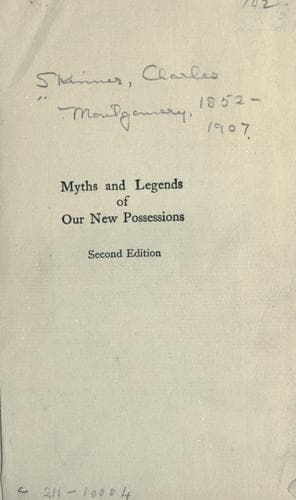
Myths & Legends of our New Possessions & ProtectorateSkinner, Charles M. (Charles Montgomery)
History
Myths & Legends of our New Possessions & Protectorate
Skinner, Charles M. (Charles Montgomery)
Tales -- Oceania; Tales -- West Indies
Perhaps the most ancient story in the world tells of the sinking of
Atlantis. When the Egyptian priest told it to Solon it was already
venerable beyond estimate; yet he recounted the work and pleasures
of the Atlantans, who were a multitude, who drank from hot and cold
springs, who had mines of silver and gold, pastures for elephants,
and plants that yielded a sweet savor; who prayed in temples of white,
red and black stone, sheathed in shining metals; whose sculptors made
vast statues, one, representing Poseidon driving winged horses, being
so large that the head of the god nearly touched the temple roof;
who had gardens, canals, sea walls, and pleasant walks; who had ten
thousand chariots in their capital alone; the port of twelve hundred
ships. They were a folk of peace and kindness, but as they increased
in wealth and comfort they forgot the laws of heaven; so in a day
and a night this continent went down, burying its millions and its
treasures beneath the waters. A few of the inhabitants escaped to
Europe in their ships; a few, also, to America. It has been claimed
that Atlantis may still be traced in an elevation of the ocean floor
about seven hundred miles wide and a thousand miles long, its greatest
length from northeast to southwest, and the Azores at its eastern
edge--mountain tops not quite submerged. As some believe, it was from
this cataclysm that has sprung the world-wide legend of a deluge.
From some of the enchanted lands, perhaps near the American shore,
Merlin went to England, piled the monoliths of Stonehenge on Salisbury
moor, and after gaining respect and fear as a magician and prophet,
sailed back across the waste. The Joyous Island of Lancelot; the island
where King Arthur wrestled and bested the Half Man; Avalon, the Isle
of the Blest, where Arthur lived in the castle of the sea-born fairy,
Morgan le Fee, were probably near the British or Irish coasts.
Public-domain text, read in full here on John Shaqi.
Reviews
Reviews
No reviews yet
Be the first to share your thoughts on this work.
Join the Discussion
Join the discussion
Sign in to leave a comment or review.
Sign InorCreate an account