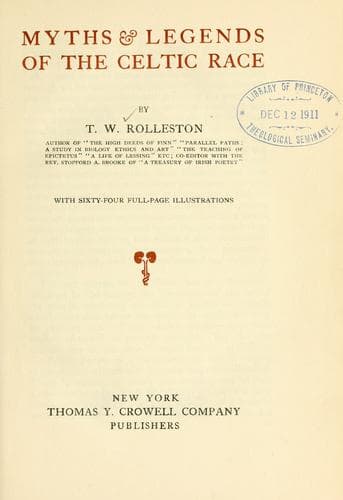
Myths & Legends of the Celtic RaceRolleston, T. W. (Thomas William)
Religion
Myths & Legends of the Celtic Race
Rolleston, T. W. (Thomas William)
Celts -- Religion; Mythology, Celtic
From this point the story of Conary Mōr takes on a character of
supernatural vastness and mystery, the imagination of the bardic narrator
dilating, as it were, with the approach of the crisis. Night has fallen,
and the pirate host of Ingcel is encamped on the shores of Dublin Bay.
They hear the noise of the royal cavalcade, and a long-sighted messenger
is sent out to discover what it is. He brings back word of the glittering
and multitudinous host which has followed Conary to the Hostel. A crashing
noise is heard—Ingcel asks of Ferrogan what it may be—it is the giant
warrior mac Cecht striking flint on steel to kindle fire for the king’s
feast. “God send that Conary be not there to-night,” cry the sons of Desa;
“woe that he should be under the hurt of his foes.” But Ingcel reminds
them of their compact—he had given them the plundering of his own father
and brethren; they cannot refuse to stand by him in the attack he
meditates on Conary in the Hostel. A glare of the fire lit by mac Cecht is
now perceived by the pirate host, shining through the wheels of the
chariots which are drawn up around the open doors of the Hostel. Another
of the _geise_ of Conary has been broken.
Ingcel and his host now proceed to build a great cairn of stones, each man
contributing one stone, so that there may be a memorial of the fight, and
also a record of the number slain when each survivor removes his stone
again.
*The Morrigan*
The scene now shifts to the Hostel, where the king’s party has arrived and
is preparing for the night. A solitary woman comes to the door and seeks
admission. “As long as a weaver’s beam were each of her two shins, and
they were as dark as the back of a stag-beetle. A greyish, woolly mantle
she wore. Her hair reached to her knee. Her mouth was twisted to one side
of her head.” It was the Morrigan, the Danaan goddess of Death and
Destruction. She leant against the doorpost of the house and looked evilly
on the king and his company. “Well, O woman,” said Conary, “if thou art a
witch, what seest thou for us?” “Truly I see for thee,” she answered,
“that neither fell nor flesh of thine shall escape from the place into
which thou hast come, save what birds will bear away in their claws.” She
asks admission. Conary declares that his _geis_ forbids him to receive a
solitary man or woman after sunset. “If in sooth,” she says, “it has
befallen the king not to have room in his house for the meal and bed of a
solitary woman, they will be gotten apart from him from some one
possessing generosity.” “Let her in, then,” says Conary, “though it is a
_geis_ of mine.”
*Conary and his Retinue*
Public-domain text, read in full here on John Shaqi.
Reviews
Reviews
No reviews yet
Be the first to share your thoughts on this work.
Elsewhere in the archive
Join the Discussion
Join the discussion
Sign in to leave a comment or review.
Sign InorCreate an account