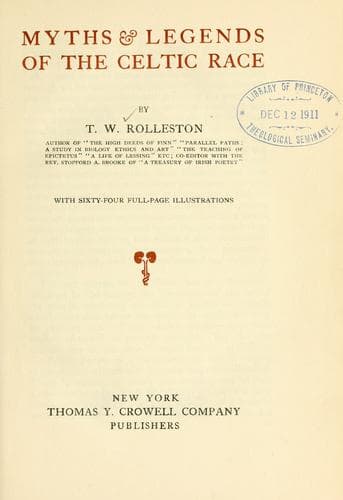
Myths & Legends of the Celtic RaceRolleston, T. W. (Thomas William)
Religion
Myths & Legends of the Celtic Race
Rolleston, T. W. (Thomas William)
Celts -- Religion; Mythology, Celtic
A lengthy and brilliant passage now follows describing how Ingcel goes to
spy out the state of affairs in the Hostel. Peeping through the
chariot-wheels, he takes note of all he sees, and describes to the sons of
Desa the appearance and equipment of each prince and mighty man in
Conary’s retinue, while Ferrogan and his brother declare who he is and
what destruction he will work in the coming fight. There is Cormac, son of
Conor, King of Ulster, the fair and good; there are three huge, black and
black-robed warriors of the Picts; there is Conary’s steward, with
bristling hair, who settles every dispute—a needle would be heard falling
when he raises his voice to speak, and he bears a staff of office the size
of a mill-shaft; there is the warrior mac Cecht, who lies supine with his
knees drawn up—they resemble two bare hills, his eyes are like lakes, his
nose a mountain-peak, his sword shines like a river in the sun. Conary’s
three sons are there, golden-haired, silk-robed, beloved of all the
household, with “manners of ripe maidens, and hearts of brothers, and
valour of bears.” When Ferrogan hears of them he weeps and cannot proceed
till hours of the night have passed. Three Fomorian hostages of horrible
aspect are there also; and Conall of the Victories with his blood-red
shield; and Duftach of Ulster with his magic spear, which, when there is a
premonition of battle, must be kept in a brew of soporific herbs, or it
will flame on its haft and fly forth raging for massacre; and three giants
from the Isle of Man with horses’ manes reaching to their heels. A strange
and unearthly touch is introduced by a description of three naked and
bleeding forms hanging by ropes from the roof—they are the daughters of
the Bav, another name for the Morrigan, or war-goddess, “three of awful
boding,” says the tale enigmatically, “those are the three that are
slaughtered at every time.” We are probably to regard them as visionary
beings, portending war and death, visible only to Ingcel. The hall with
its separate chambers is full of warriors, cup-bearers, musicians playing,
and jugglers doing wonderful feats; and Da Derga with his attendants
dispensing food and drink. Conary himself is described as a youth; “the
ardour and energy of a king has he and the counsel of a sage; the mantle I
saw round him is even as the mist of May-day—lovelier in each hue of it
than the other.” His golden-hilted sword lies beside him—a forearm’s
length of it has escaped from the scabbard, shining like a beam of light.
“He is the mildest and gentlest and most perfect king that has come into
the world, even Conary son of Eterskel ... great is the tenderness of the
sleepy, simple man till he has chanced on a deed of valour. But if his
fury and his courage are awakened when the champions of Erin and Alba are
at him in the house, the Destruction will not be wrought so long as he is
therein ... sad were the quenching of that reign.”
*Champions at the House*
Public-domain text, read in full here on John Shaqi.
Reviews
Reviews
No reviews yet
Be the first to share your thoughts on this work.
Elsewhere in the archive
Join the Discussion
Join the discussion
Sign in to leave a comment or review.
Sign InorCreate an account