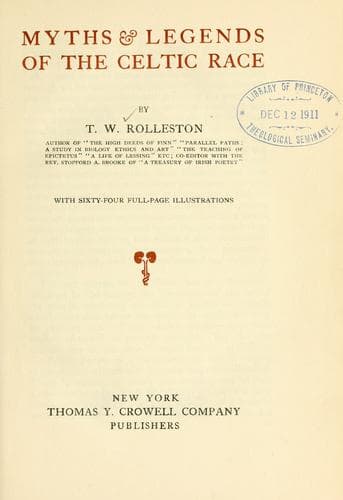
Myths & Legends of the Celtic RaceRolleston, T. W. (Thomas William)
Religion
Myths & Legends of the Celtic Race
Rolleston, T. W. (Thomas William)
Celts -- Religion; Mythology, Celtic
The great warrior-queen had reigned in Connacht, it was said, for
eighty-eight years. She is a signal example of the kind of women whom the
Gaelic bards delighted to portray. Gentleness and modesty were by no means
their usual characteristics, but rather a fierce overflowing life.
Women-warriors like Skatha and Aifa are frequently met with, and one is
reminded of the Gaulish women, with their mighty snow-white arms, so
dangerous to provoke, of whom classical writers tell us. The Gaelic bards,
who in so many ways anticipated the ideas of chivalric romance, did not do
so in setting women in a place apart from men. Women were judged and
treated like men, neither as drudges nor as goddesses, and we know that
well into historic times they went with men into battle, a practice only
ended in the sixth century.
*Fergus mac Leda and the Wee Folk*
Of the stories of the Ultonian Cycle which do not centre on the figure of
Cuchulain, one of the most interesting is that of Fergus mac Leda and the
King of the Wee Folk. In this tale Fergus appears as King of Ulster, but
as he was contemporary with Conor mac Nessa, and in the Cattle Raid of
Quelgny is represented as following him to war, we must conclude that he
was really a sub-king, like Cuchulain or Owen of Ferney.
The tale opens in Faylinn, or the Land of the Wee Folk, a race of elves
presenting an amusing parody of human institutions on a reduced scale, but
endowed (like dwarfish people generally in the literature of primitive
races) with magical powers. Iubdan,(170) the King of Faylinn, when flushed
with wine at a feast, is bragging of the greatness of his power and the
invincibility of his armed forces—have they not the strong man Glower, who
with his axe has been known to hew down a thistle at a stroke? But the
king’s bard, Eisirt, has heard something of a giant race oversea in a land
called Ulster, one man of whom would annihilate a whole battalion of the
Wee Folk, and he incautiously allows himself to hint as much to the
boastful monarch. He is immediately clapped into prison for his audacity,
and only gets free by promising to go immediately to the land of the
mighty men, and bring back evidence of the truth of his incredible story.
Public-domain text, read in full here on John Shaqi.
Reviews
Reviews
No reviews yet
Be the first to share your thoughts on this work.
Elsewhere in the archive
Join the Discussion
Join the discussion
Sign in to leave a comment or review.
Sign InorCreate an account