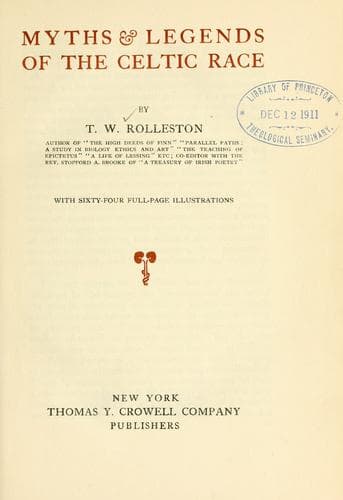
Myths & Legends of the Celtic RaceRolleston, T. W. (Thomas William)
Religion
Myths & Legends of the Celtic Race
Rolleston, T. W. (Thomas William)
Celts -- Religion; Mythology, Celtic
So off he goes; and one fine day King Fergus and his lords find at the
gate of their Dūn a tiny little fellow magnificently clad in the robes of
a royal bard, who demands entrance. He is borne in upon the hand of Æda,
the king’s dwarf and bard, and after charming the court by his wise and
witty sayings, and receiving a noble largesse, which he at once
distributes among the poets and other court attendants of Ulster, he goes
off home, taking with him as a guest the dwarf Æda, before whom the Wee
Folk fly as a “Fomorian giant,” although, as Eisirt explains, the average
man of Ulster can carry him like a child. Iubdan is now convinced, but
Eisirt puts him under _geise_, the bond of chivalry which no Irish
chieftain can repudiate without being shamed, to go himself, as Eisirt has
done, to the palace of Fergus and taste the king’s porridge. Iubdan, after
he has seen Æda, is much dismayed, but he prepares to go, and bids Bebo,
his wife, accompany him. “You did an ill deed,” she says, “when you
condemned Eisirt to prison; but surely there is no man under the sun that
can make thee hear reason.”
So off they go, and Iubdan’s fairy steed bears them over the sea till they
reach Ulster, and by midnight they stand before the king’s palace. “Let us
taste the porridge as we were bound,” says Bebo, “and make off before
daybreak.” They steal in and find the porridge-pot, to the rim of which
Iubdan can only reach by standing on his horse’s back. In straining
downwards to get at the porridge he overbalances himself and falls in.
There in the thick porridge he sticks fast, and there Fergus’s scullions
find him at the break of day, with the faithful Bebo lamenting. They bear
him off to Fergus, who is amazed at finding another wee man, with a woman
too, in his palace. He treats them hospitably, but refuses all appeals to
let them go. The story now recounts in a spirit of broad humour several
Rabelaisian adventures in which Bebo is concerned, and gives a charming
poem supposed to have been uttered by Iubdan in the form of advice to
Fergus’s fire-gillie as to the merits for burning of different kinds of
timber. The following are extracts:
“Burn not the sweet apple-tree of drooping branches, of the white
blossoms, to whose gracious head each man puts forth his hand.”
“Burn not the noble willow, the unfailing ornament of poems; bees
drink from its blossoms, all delight in the graceful tent.”
“The delicate, airy tree of the Druids, the rowan with its
berries, this burn; but avoid the weak tree, burn not the slender
hazel.”
“The ash-tree of the black buds burn not—timber that speeds the
wheel, that yields the rider his switch; the ashen spear is the
scale-beam of battle.”
Public-domain text, read in full here on John Shaqi.
Reviews
Reviews
No reviews yet
Be the first to share your thoughts on this work.
Elsewhere in the archive
Join the Discussion
Join the discussion
Sign in to leave a comment or review.
Sign InorCreate an account