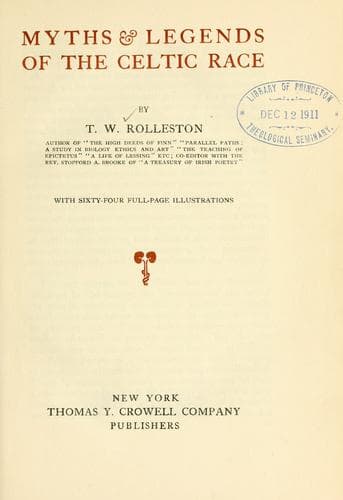
Myths & Legends of the Celtic RaceRolleston, T. W. (Thomas William)
Religion
Myths & Legends of the Celtic Race
Rolleston, T. W. (Thomas William)
Celts -- Religion; Mythology, Celtic
Some of these references have already been quoted, and we need not repeat
the evidence derived from Plato, Ephorus, or Arrian. But an observation of
M. Porcius Cato on the Gauls may be adduced. “There are two things,” he
says, “to which the Gauls are devoted—the art of war and subtlety of
speech” (“rem militarem et argute loqui”).
*Cæsar’s Account*
Cæsar has given us a careful and critical account of them as he knew them
in Gaul. They were, he says, eager for battle, but easily dashed by
reverses. They were extremely superstitious, submitting to their Druids in
all public and private affairs, and regarding it as the worst of
punishments to be excommunicated and forbidden to approach thu ceremonies
of religion:
“They who are thus interdicted [for refusing to obey a Druidical
sentence] are reckoned in the number of the vile and wicked; all
persons avoid and fly their company and discourse, lest they
should receive any infection by contagion; they are not permitted
to commence a suit; neither is any post entrusted to them.... The
Druids are generally freed from military service, nor do they pay
taxes with the rest.... Encouraged by such rewards, many of their
own accord come to their schools, and are sent by their friends
and relations. They are said there to get by heart a great number
of verses; some continue twenty years in their education; neither
is it held lawful to commit these things [the Druidic doctrines]
to writing, though in almost all public transactions and private
accounts they use the Greek characters.”
Public-domain text, read in full here on John Shaqi.
Reviews
Reviews
No reviews yet
Be the first to share your thoughts on this work.
Join the Discussion
Join the discussion
Sign in to leave a comment or review.
Sign InorCreate an account