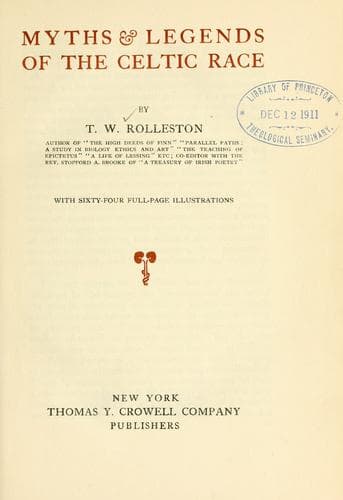
Myths & Legends of the Celtic RaceRolleston, T. W. (Thomas William)
Religion
Myths & Legends of the Celtic Race
Rolleston, T. W. (Thomas William)
Celts -- Religion; Mythology, Celtic
This fine tale has been published in full from an Egerton MS., by Mr.
Standish Hayes O’Grady, in his “Silva Gadelica.” The humorous treatment of
the fairy element in the story would mark it as belonging to a late period
of Irish legend, but the tragic and noble conclusion unmistakably signs it
as belonging to the Ulster bardic literature, and it falls within the same
order of ideas, if it were not composed within the same period, as the
tales of Cuchulain.
*Significance of Irish Place-Names*
Before leaving this great cycle of legendary literature let us notice what
has already, perhaps, attracted the attention of some readers—the extent
to which its chief characters and episodes have been commemorated in the
still surviving place-names of the country.(171) This is true of Irish
legend in general—it is especially so of the Ultonian Cycle. Faithfully
indeed, through many a century of darkness and forgetting, have these
names pointed to the hidden treasures of heroic romance which the labours
of our own day are now restoring to light. The name of the little town of
Ardee, as we have seen,(172) commemorates the tragic death of Ferdia at
the hand of his “heart companion,” the noblest hero of the Gael. The ruins
of Dūn Baruch, where Fergus was bidden to the treacherous feast, still
look over the waters of Moyle, across which Naisi and Deirdre sailed to
their doom. Ardnurchar, the Hill of the Sling-cast, in Westmeath,(173)
brings to mind the story of the stately monarch, the crowd of gazing
women, and the crouching enemy with the deadly missile which bore the
vengeance of Mesgedra. The name of Armagh, or Ard Macha, the Hill of
Macha, enshrines the memory of the Fairy Bride and her heroic sacrifice,
while the grassy rampart can still be traced where the war-goddess in the
earlier legend drew its outline with the pin of her brooch when she
founded the royal fortress of Ulster. Many pages might be filled with
these instances. Perhaps no modern country has place-names so charged with
legendary associations as are those of Ireland. Poetry and myth are there
still closely wedded to the very soil of the land—a fact in which there
lies ready to hand an agency for education, for inspiration, of the
noblest kind, if we only had the insight to see it and the art to make use
of it.
CHAPTER VI: TALES OF THE OSSIANIC CYCLE
*The Fianna of Erin*
Public-domain text, read in full here on John Shaqi.
Reviews
Reviews
No reviews yet
Be the first to share your thoughts on this work.
Elsewhere in the archive
Join the Discussion
Join the discussion
Sign in to leave a comment or review.
Sign InorCreate an account