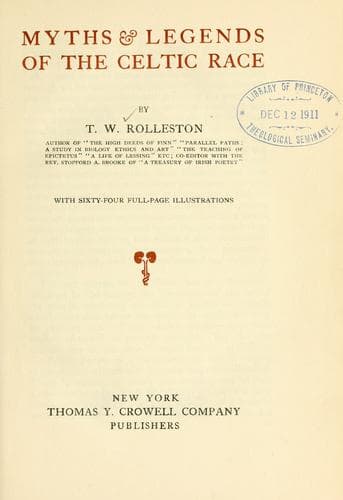
Myths & Legends of the Celtic RaceRolleston, T. W. (Thomas William)
Religion
Myths & Legends of the Celtic Race
Rolleston, T. W. (Thomas William)
Celts -- Religion; Mythology, Celtic
As the tales of the Ultonian Cycle cluster round the heroic figure of the
Hound of Cullan, so do those of the Ossianic Cycle round that of Finn mac
Cumhal,(174) whose son Oisīn(175) (or Ossian, as Macpherson called him in
the pretended translations from the Gaelic which first introduced him to
the English-speaking world) was a poet as well as a warrior, and is the
traditional author of most of them. The events of the Ultonian Cycle are
supposed to have taken place about the time of the birth of Christ. Those
of the Ossianic Cycle fell mostly in the reign of Cormac mac Art, who
lived in the third century A.D. During his reign the Fianna of Erin, who
are represented as a kind of military Order composed mainly of the members
of two clans, Clan Bascna and Clan Morna, and who were supposed to be
devoted to the service of the High King and to the repelling of foreign
invaders, reached the height of their renown under the captaincy of Finn.
The annalists of ancient Ireland treated the story of Finn and the Fianna,
in its main outlines, as sober history. This it can hardly be. Ireland had
no foreign invaders during the period when the Fianna are supposed to have
flourished, and the tales do not throw a ray of light on the real history
of the country; they are far more concerned with a Fairyland populated by
supernatural beings, beautiful or terrible, than with any tract of real
earth inhabited by real men and women. The modern critical reader of these
tales will soon feel that it would be idle to seek for any basis of fact
in this glittering mirage. But the mirage was created by poets and
storytellers of such rare gifts for this kind of literature that it took
at once an extraordinary hold on the imagination of the Irish and Scottish
Gael.
*The Ossianic Cycle*
The earliest tales of this cycle now extant are found in manuscripts of
the eleventh and twelfth centuries, and were composed probably a couple of
centuries earlier. But the cycle lasted in a condition of vital growth for
a thousand years, right down to Michael Comyn’s “Lay of Oisin in the Land
of Youth,” which was composed about 1750, and which ended the long history
of Gaelic literature.(176) It has been estimated(177) that if all the
tales and poems of the Ossianic Cycle which still remain could be printed
they would fill some twenty-five volumes the size of this. Moreover, a
very great proportion of this literature, even if there were no
manuscripts at all, could during the last and the preceding centuries have
been recovered from the lips of what has been absurdly called an
“illiterate” peasantry in the Highlands and in the Gaelic-speaking parts
or Ireland. It cannot but interest us to study the character of the
literature which was capable of exercising such a spell.
*Contrasted with the Ultonian Cycle*
Public-domain text, read in full here on John Shaqi.
Reviews
Reviews
No reviews yet
Be the first to share your thoughts on this work.
Elsewhere in the archive
Join the Discussion
Join the discussion
Sign in to leave a comment or review.
Sign InorCreate an account