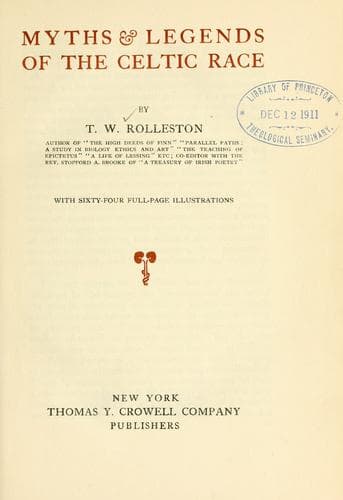
Myths & Legends of the Celtic RaceRolleston, T. W. (Thomas William)
Religion
Myths & Legends of the Celtic Race
Rolleston, T. W. (Thomas William)
Celts -- Religion; Mythology, Celtic
and the Fianna buried her under a great mound, and raised a pillar stone
over her with her name in Ogham letters, in the place since called the
Ridge of the Dead Woman.
In this tale we have, besides the element of mystery, that of beauty. It
is an association of frequent occurrence in this period of Celtic
literature; and to this, perhaps, is due the fact that although these
tales seem to come from nowhither and to lead nowhither, but move in a
dream-world where there is no chase but seems to end in Fairyland and no
combat that has any relation to earthly needs or objects, where all
realities are apt to dissolve in a magic light and to change their shapes
like morning mist, yet they linger in the memory with that haunting charm
which has for many centuries kept them alive by the fireside of the Gaelic
peasant.
*St. Patrick, Oisīn, and Keelta*
Before we leave the “Colloquy” another interesting point must be mentioned
in connexion with it. To the general public probably the best-known things
in Ossianic literature—I refer, of course, to the true Gaelic poetry which
goes under that name, not to the pseudo-Ossian of Macpherson—are those
dialogues in which the pagan and the Christian ideals are contrasted,
often in a spirit of humorous exaggeration or of satire. The earliest of
these pieces are found in the manuscript called “The Dean of Lismore’s
Book,” in which James Macgregor, Dean of Lismore in Argyllshire,wrote
down, some time before the year 1518, all he could remember or discover of
traditional Gaelic poetry in his time. It may be observed that up to this
period, and, indeed, long after it, Scottish and Irish Gaelic were one
language and one literature, the great written monuments of which were in
Ireland, though they belonged just as much to the Highland Celt, and the
two branches of the Gael had an absolutely common stock of poetic
tradition. These Oisīn-and-Patrick dialogues are found in abundance both
in Ireland and in the Highlands, though, as I have said, “The Dean of
Lismore’s Book” is their first written record now extant. What relation,
then, do these dialogues bear to the Keelta-and-Patrick dialogues with
which we make acquaintance in the “Colloquy”? The questions which really
came first, where they respectively originated, and what current of
thought or sentiment each represented, constitute, as Mr. Alfred Nutt has
pointed out, a literary problem of the greatest interest; and one which no
critic has yet attempted to solve, or, indeed, until quite lately, even to
call attention to. For though these two attempts to represent, in
imaginative and artistic form, the contact of paganism with Christianity
are nearly identical in machinery and framework, save that one is in verse
and the other in prose, yet they differ widely in their point of view.
Public-domain text, read in full here on John Shaqi.
Reviews
Reviews
No reviews yet
Be the first to share your thoughts on this work.
Elsewhere in the archive
Join the Discussion
Join the discussion
Sign in to leave a comment or review.
Sign InorCreate an account