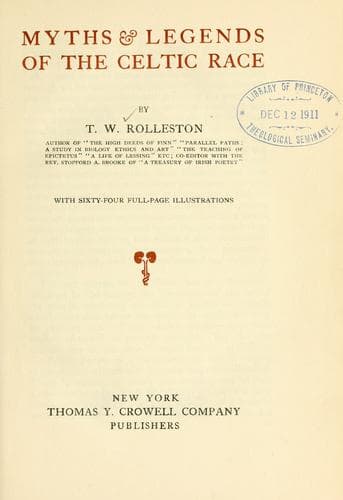
Myths & Legends of the Celtic RaceRolleston, T. W. (Thomas William)
Religion
Myths & Legends of the Celtic Race
Rolleston, T. W. (Thomas William)
Celts -- Religion; Mythology, Celtic
In the Oisīn dialogues(186) there is a great deal of rough humour and of
crude theology, resembling those of an English miracle-play rather than
any Celtic product that I am acquainted with. St. Patrick in these
ballads, as Mr. Nutt remarks, “is a sour and stupid fanatic, harping with
wearisome monotony on the damnation of Finn and all his comrades; a hard
taskmaster to the poor old blind giant to whom he grudges food, and upon
whom he plays shabby tricks in order to terrify him into acceptance of
Christianity.” Now in the “Colloquy” there is not one word of all this.
Keelta embraces Christianity with a wholehearted reverence, and salvation
is not denied to the friends and companions of his youth. Patrick, indeed,
assures Keelta of the salvation of several of them, including Finn
himself. One of the Danaan Folk, who has been bard to the Fianna,
delighted Patrick with his minstrelsy. Brogan, the scribe whom St. Patrick
is employing to write down the Fian legends, says: “If music there is in
heaven, why should there not be on earth? Wherefore it is not right to
banish minstrelsy.” Patrick made answer: “Neither say I any such thing”;
and, in fact, the minstrel is promised heaven for his art.
Such are the pleasant relations that prevail in the “Colloquy” between the
representatives of the two epochs. Keelta represents all that is
courteous, dignified, generous, and valorous in paganism, and Patrick all
that is benign and gracious in Christianity; and instead of the two epochs
standing over against each other in violent antagonism, and separated by
an impassable gulf, all the finest traits in each are seen to harmonise
with and to supplement those of the other.
*Tales of Dermot*
A number of curious legends centre on Dermot O’Dyna, who has been referred
to as one of Finn mac Cumhal’s most notable followers. He might be
described as a kind of Gaelic Adonis, a type of beauty and attraction, the
hero of innumerable love tales; and, like Adonis, his death was caused by
a wild boar.
*The Boar of Ben Bulben*
The boar was no common beast. The story of its origin was as follows:
Dermot’s father, Donn, gave the child to be nurtured by Angus Ōg in his
palace on the Boyne. His mother, who was unfaithful to Donn, bore another
child to Roc, the steward of Angus. Donn, one day, when the steward’s
child ran between his knees to escape from some hounds that were fighting
on the floor of the hall, gave him a squeeze with his two knees that
killed him on the spot, and he then flung the body among the hounds on the
floor. When the steward found his son dead, and discovered (with Finn’s
aid) the cause of it, he brought a Druid rod and smote the body with it,
whereupon, in place of the dead child, there arose a huge boar, without
ears or tail; and to it he spake: “I charge you to bring Dermot O’Dyna to
his death”; and the boar rushed out from the hall and roamed in the
forests of Ben Bulben in Co. Sligo till the time when his destiny should
be fulfilled.
Public-domain text, read in full here on John Shaqi.
Reviews
Reviews
No reviews yet
Be the first to share your thoughts on this work.
Elsewhere in the archive
Join the Discussion
Join the discussion
Sign in to leave a comment or review.
Sign InorCreate an account