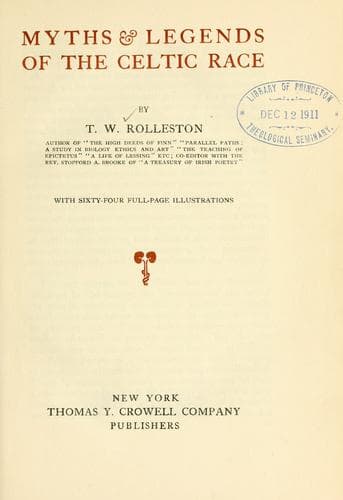
Myths & Legends of the Celtic RaceRolleston, T. W. (Thomas William)
Religion
Myths & Legends of the Celtic Race
Rolleston, T. W. (Thomas William)
Celts -- Religion; Mythology, Celtic
Nothing can better illustrate the difference between the two cycles than a
comparison of the tale of Deirdre with that with which we have now to
deal—the tale of Dermot and Grania. The latter, from one point of view,
reads like an echo of the former, so close is the resemblance between them
in the outline of the plot. Take the following skeleton story: “A fair
maiden is betrothed to a renowned and mighty suitor much older than
herself. She turns from him to seek a younger lover, and fixes her
attention on one of his followers, a gallant and beautiful youth, whom she
persuades, in spite of his reluctance, to fly with her. After evading
pursuit they settle down for a while at a distance from the defrauded
lover, who bides his time, till at last, under cover of a treacherous
reconciliation, he procures the death of his younger rival and retakes
possession of the lady.” Were a student of Celtic legend asked to listen
to the above synopsis, and to say to what Irish tale it referred, he would
certainly reply that it must be either the tale of the Pursuit of Dermot
and Grania, or that of the Fate of the Sons of Usna; but which of them it
was it would be quite impossible for him to tell. Yet in tone and temper
the two stories are as wide apart as the poles.
*Grania and Dermot*
Grania, in the Fian story, is the daughter of Cormac mac Art, High King of
Ireland. She is betrothed to Finn mac Cumhal, whom we are to regard at
this period as an old and war-worn but still mighty warrior. The famous
captains of the Fianna all assemble at Tara for the wedding feast, and as
they sit at meat Grania surveys them and asks their names of her father’s
Druid, Dara. “It is a wonder,” she says, “that Finn did not ask me for
Oisīn, rather than for himself.” “Oisīn would not dare to take thee,” says
Dara. Grania, after going through all the company, asks: “Who is that man
with the spot on his brow, with the sweet voice, with curling dusky hair
and ruddy cheek?” “That is Dermot O’Dyna,” replies the Druid, “the
white-toothed, of the lightsome countenance, in all the world the best
lover of women and maidens.” Grania now prepares a sleepy draught, which
she places in a drinking-cup and passes round by her handmaid to the king,
to Finn, and to all the company except the chiefs of the Fianna. When the
draught has done its work she goes to Oisīn. “Wilt thou receive courtship
from me, Oisīn?” she asks. “That will I not,” says Oisīn, “nor from any
woman that is betrothed to Finn.” Grania, who knew very well what Oisīn’s
answer would be, now turns to her real mark, Dermot. He at first refuses
to have anything to do with her. “I put thee under bonds [_geise_], O
Dermot, that thou take me out of Tara to-night.” “Evil are these bonds,
Grania,” says Dermot; “and wherefore hast thou put them on me before all
the kings’ sons that feast at this table?” Grania then explains that she
has loved Dermot ever since she saw him, years ago, from her sunny bower,
Public-domain text, read in full here on John Shaqi.
Reviews
Reviews
No reviews yet
Be the first to share your thoughts on this work.
Elsewhere in the archive
Join the Discussion
Join the discussion
Sign in to leave a comment or review.
Sign InorCreate an account