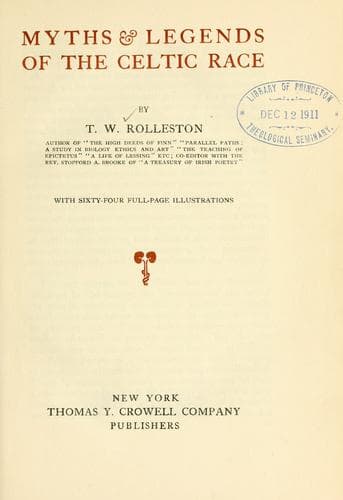
Myths & Legends of the Celtic RaceRolleston, T. W. (Thomas William)
Religion
Myths & Legends of the Celtic Race
Rolleston, T. W. (Thomas William)
Celts -- Religion; Mythology, Celtic
To a tale like this modern taste demands a romantic and sentimental
ending; and such has actually been given to it in the retelling by Dr. P.
W. Joyce in his “Old Celtic Romances,” as it has to the tale of Deirdre by
almost every modern writer who has handled it.(190) But the Celtic
story-teller felt differently. The tale of the end of Deirdre is horribly
cruel, that of Grania cynical and mocking; neither is in the least
sentimental. Grania is at first enraged with Finn, and sends her sons
abroad to learn feats of arms, so that they may take vengeance upon him
when the time is ripe. But Finn, wily and far-seeing as he is portrayed in
this tale, knows how to forestall this danger. When the tragedy on Ben
Bulben has begun to grow a little faint in the shallow soul of Grania, he
betakes himself to her, and though met at first with scorn and indignation
he woos her so sweetly and with such tenderness that at last he brings her
to his will, and he bears her back as a bride to the Hill of Allen. When
the Fianna see the pair coming towards them in this loving guise they
burst into a shout of laughter and derision, “so that Grania bowed her
head in shame.” “We trow, O Finn,” cries Oisīn, “that thou wilt keep
Grania well from henceforth.” So Grania made peace between Finn and her
sons, and dwelt with Finn as his wife until he died.
*Two Streams of Fian Legends*
It will be noticed that in this legend Finn does not appear as a
sympathetic character. Our interest is all on the side of Dermot. In this
aspect of it the tale is typical of a certain class of Fian stories. Just
as there were two rival clans within the Fian organisation—the Clan Bascna
and the Clan Morna—who sometimes came to blows for the supremacy, so there
are two streams of legends seeming to flow respectively from one or other
of these sources, in one of which Finn is glorified, while in the other he
is belittled in favour of Goll mac Morna or any other hero with whom he
comes into conflict.
*End of the Fianna*
The story of the end of the Fianna is told in a number of pieces, some
prose, some poetry, all of them, however, agreeing in presenting this
event as a piece of sober history, without any of the supernatural and
mystical atmosphere in which nearly all the Fian legends are steeped.
Public-domain text, read in full here on John Shaqi.
Reviews
Reviews
No reviews yet
Be the first to share your thoughts on this work.
Elsewhere in the archive
Join the Discussion
Join the discussion
Sign in to leave a comment or review.
Sign InorCreate an account