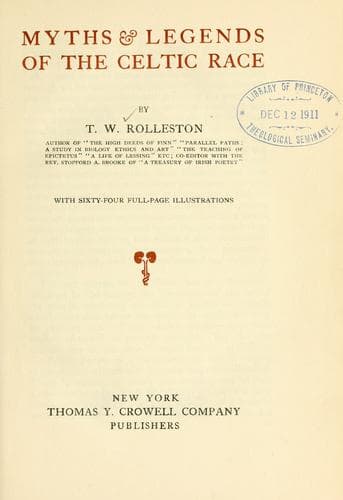
Myths & Legends of the Celtic RaceRolleston, T. W. (Thomas William)
Religion
Myths & Legends of the Celtic Race
Rolleston, T. W. (Thomas William)
Celts -- Religion; Mythology, Celtic
After the death of Cormac mac Art his son Cairbry came to the
High-Kingship of Ireland. He had a fair daughter named _Sgeimh Solais_
(Light of Beauty), who was asked in marriage by a son of the King of the
Decies. The marriage was arranged, and the Fianna claimed a ransom or
tribute of twenty ingots of gold, which, it is said, was customarily paid
to them on these occasions. It would seem that the Fianna had now grown to
be a distinct power within the State, and an oppressive one, exacting
heavy tributes and burdensome privileges from kings and sub-kings all over
Ireland. Cairbry resolved to break them; and he thought he had now a good
opportunity to do so. He therefore refused payment of the ransom, and
summoned all the provincial kings to help him against the Fianna, the main
body of whom immediately went into rebellion for what they deemed their
rights. The old feud between Clan Bascna and Clan Morna now broke out
afresh, the latter standing by the High King, while Clan Bascna, aided by
the King of Munster and his forces, who alone took their side, marched
against Cairbry.
*The Battle of Gowra*
All this sounds very matter-of-fact and probable, but how much real
history there may be in it it is very hard to say. The decisive battle of
the war which ensued took place at Gowra (Gabhra), the name of which
survives in Garristown, Co. Dublin. The rival forces, when drawn up in
battle array, knelt and kissed the sacred soil of Erin before they
charged. The story of the battle in the poetical versions, one of which is
published in the Ossianic Society’s “Transactions,” and another and finer
one in Campbell’s “The Fians,”(191) is supposed to be related by Oisīn to
St. Patrick. He lays great stress on the feats of his son Oscar:
“My son urged his course
Through the battalions of Tara
Like a hawk through a flock of birds,
Or a rock descending a mountain-side.”
*The Death of Oscar*
The fight was _à outrance_, and the slaughter on both sides tremendous.
None but old men and boys, it is said, were left in Erin after that fight.
The Fianna were in the end almost entirely exterminated, and Oscar slain.
He and the King of Ireland, Cairbry, met in single combat, and each of
them slew the other. While Oscar was still breathing, though there was not
a palm’s breadth on his body without a wound, his father found him:
“I found my own son lying down
On his left elbow, his shield by his side;
His right hand clutched the sword,
The blood poured through his mail
“Oscar gazed up at me—
Woe to me was that sight!
He stretched out his two arms to me,
Endeavouring to rise to meet me.
“I grasped the hand of my son
And sat down by his left side;
And since I sat by him there,
I have recked nought of the world.”
When Finn (in the Scottish version) comes to bewail his grandson, he
cries:
“Woe, that it was not I who fell
In the fight of bare sunny Gavra,
And you were east and west
Marching before the Fians, Oscar.”
But Oscar replies:
Public-domain text, read in full here on John Shaqi.
Reviews
Reviews
No reviews yet
Be the first to share your thoughts on this work.
Elsewhere in the archive
Join the Discussion
Join the discussion
Sign in to leave a comment or review.
Sign InorCreate an account