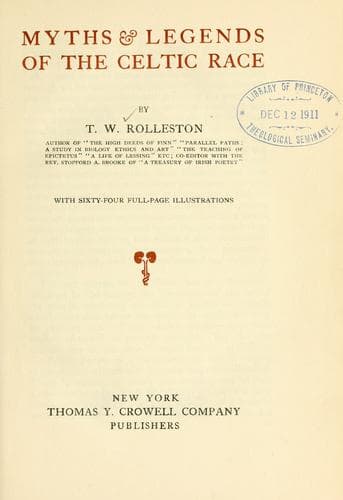
Myths & Legends of the Celtic RaceRolleston, T. W. (Thomas William)
Religion
Myths & Legends of the Celtic Race
Rolleston, T. W. (Thomas William)
Celts -- Religion; Mythology, Celtic
In due time a son was born to the woman and she called his name Maeldūn.
He was taken secretly to her friend, the queen of the territory, and by
her Maeldūn was reared. “Beautiful indeed was his form, and it is doubtful
if there hath been in flesh any one so beautiful as he. So he grew up till
he was a young warrior and fit to use weapons. Great, then, was his
brightness and his gaiety and his playfulness. In his play he outwent all
his comrades in throwing balls, and in running and leaping and putting
stones and racing horses.”
One day a proud young warrior who had been defeated by him taunted him
with his lack of knowledge of his kindred and descent. Maeldūn went to his
foster-mother, the queen, and said: “I will not eat nor drink till thou
tell me who are my mother and my father.” “I am thy mother,” said the
queen, “for none ever loved her son more than I love thee.” But Maeldūn
insisted on knowing all, and the queen at last took him to his own mother,
the nun, who told him: “Thy father was Ailill of the Owens of Aran.” Then
Maeldūn went to his own kindred, and was well received by them; and with
him he took as guests his three beloved foster-brothers, sons of the king
and queen who had brought him up.
After a time Maeldūn happened to be among a company of young warriors who
were contending at putting the stone in the graveyard of the ruined church
of Doocloone. Maeldūn’s foot was planted, as he heaved the stone, on a
scorched and blackened flagstone; and one who was by, a monk named
Briccne,(192) said to him: “It were better for thee to avenge the man who
was burnt there than to cast stones over his burnt bones.”
“Who was that?” asked Maeldūn.
“Ailill, thy father,” they told him.
“Who slew him?” said he.
“Reavers from Leix,” they said, “and they destroyed him on this spot.”
Then Maeldūn threw down the stone he was about to cast, and put his mantle
round him and went home; and he asked the way to Leix. They told him he
could only go there by sea.(193)
At the advice of a Druid he then built him a boat, or coracle, of skins
lapped threefold one over the other; and the wizard also told him that
seventeen men only must accompany him, and on what day he must begin the
boat and on what day he must put out to sea.
So when his company was ready he put out and hoisted the sail, but had
gone only a little way when his three foster-brothers came down to the
beach and entreated him to take them. “Get you home,” said Maeldūn, “for
none but the number I have may go with me.” But the three youths would not
be separated from Maeldūn, and they flung themselves into the sea. He
turned back, lest they should be drowned, and brought them into his boat.
All, as we shall see, were punished for this transgression, and Maeldūn
condemned to wandering until expiation had been made.
Public-domain text, read in full here on John Shaqi.
Reviews
Reviews
No reviews yet
Be the first to share your thoughts on this work.
Elsewhere in the archive
Join the Discussion
Join the discussion
Sign in to leave a comment or review.
Sign InorCreate an account