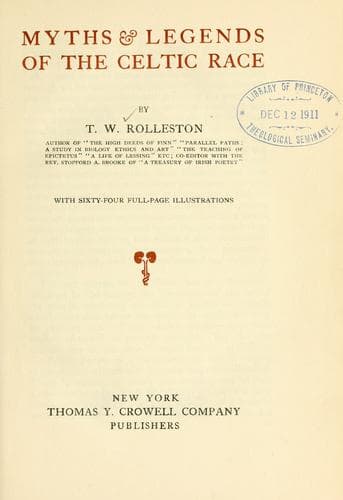
Myths & Legends of the Celtic RaceRolleston, T. W. (Thomas William)
Religion
Myths & Legends of the Celtic Race
Rolleston, T. W. (Thomas William)
Celts -- Religion; Mythology, Celtic
Besides the legends which cluster round great heroic names, and have, or
at least pretend to have, the character of history, there are many others,
great and small, which tell of adventures lying purely in regions of
romance, and out of earthly space and time. As a specimen of these I give
here a summary of the “Voyage of Maeldūn,” a most curious and brilliant
piece of invention, which is found in the manuscript entitled the “Book of
the Dun Cow” (about 1100) and other early sources, and edited, with a
translation (to which I owe the following extracts), by Dr. Whitley Stokes
in the “Revue Celtique” for 1888 and 1889. It is only one of a number of
such wonder-voyages found in ancient Irish literature, but it is believed
to have been the earliest of them all and model for the rest, and it has
had the distinction, in the abridged and modified form given by Joyce in
his “Old Celtic Romances,” of having furnished the theme for the “Voyage
of Maeldune” to Tennyson, who made it into a wonderful creation of rhythm
and colour, embodying a kind of allegory of Irish history. It will be
noticed at the end that we are in the unusual position of knowing the name
of the author of this piece of primitive literature, though he does not
claim to have composed, but only to have “put in order,” the incidents of
the “Voyage.” Unfortunately we cannot tell when he lived, but the tale as
we have it probably dates from the ninth century. Its atmosphere is
entirely Christian, and it has no mythological significance except in so
far as it teaches the lesson that the oracular injunctions of wizards
should be obeyed. No adventure, or even detail, of importance is omitted
in the following summary of the story, which is given thus fully because
the reader may take it as representing a large and important section of
Irish legendary romance. Apart from the source to which I am indebted, the
“Revue Celtique,” I know no other faithful reproduction in English of this
wonderful tale.
The “Voyage of Maeldūn” begins, as Irish tales often do, by telling us of
the conception of its hero.
There was a famous man of the sept of the Owens of Aran, named Ailill
Edge-of-Battle, who went with his king on a foray into another territory.
They encamped one night near a church and convent of nuns. At midnight
Ailill, who was near the church, saw a certain nun come out to strike the
bell for nocturns, and caught her by the hand. In ancient Ireland
religious persons were not much respected in time of war, and Ailill did
not respect her. When they parted, she said to him: “Whence is thy race,
and what is thy name?” Said the hero: “Ailill of the Edge-of-Battle is my
name, and I am of the Owenacht of Aran, in Thomond.”
Not long afterwards Ailill was slain by reavers from Leix, who burned the
church of Doocloone over his head.
Public-domain text, read in full here on John Shaqi.
Reviews
Reviews
No reviews yet
Be the first to share your thoughts on this work.
Elsewhere in the archive
Join the Discussion
Join the discussion
Sign in to leave a comment or review.
Sign InorCreate an account