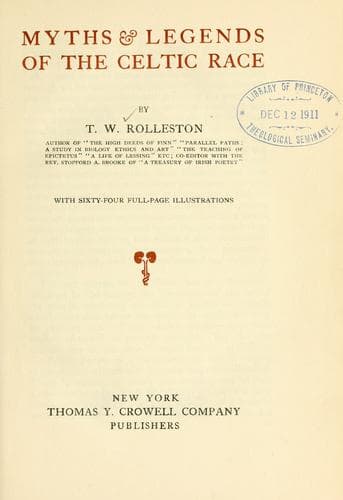
Myths & Legends of the Celtic RaceRolleston, T. W. (Thomas William)
Religion
Myths & Legends of the Celtic Race
Rolleston, T. W. (Thomas William)
Celts -- Religion; Mythology, Celtic
The monk thereupon flung everything into the sea save one little wooden
cup, and he cast away oars and rudder. The man gave him a provision of
whey and seven cakes, and bade him abide wherever his boat should stop.
The wind and waves carried him hither and thither till at last the boat
came to rest upon the rock where the wanderers found him. There was
nothing there but the bare rock, but remembering what he was bidden he
stepped out upon a little ledge over which the waves washed, and the boat
immediately left him, and the rock was enlarged for him. There he remained
seven years, nourished by otters which brought him salmon out of the sea,
and even flaming firewood on which to cook them, and his cup was filled
with good liquor every day. “And neither wet nor heat nor cold affects me
in this place.”
At the noon hour miraculous nourishment was brought for the whole crew,
and thereafter the ancient man said to them:
“Ye will all reach your country, and the man that slew thy father, O
Maeldūn, ye will find him in a fortress before you. And slay him not, but
forgive him; because God hath saved you from manifold great perils, and ye
too are men deserving of death.”
Then they bade him farewell and went on their accustomed way.
*The Island of the Falcon*
This is uninhabited save for herds of sheep and oxen. They land on it and
eat their fill, and one of them sees there a large falcon. “This falcon,”
he says, “is like the falcons of Ireland.” “Watch it,” says Maeldūn, “and
see how it will go from us.” It flew off to the south-east, and they rowed
after it all day till vespers.
*The Home-coming*
At nightfall they sighted a land like Ireland; and soon came to a small
island, where they ran their prow ashore. It was the island where dwelt
the man who had slain Ailill.
They went up to the dūn that was on the island, and heard men talking
within it as they sat at meat. One man said:
“It would be ill for us if we saw Maeldūn now.”
“That Maeldūn has been drowned,” said another.
“Maybe it is he who shall waken you from sleep to-night,” said a third.
“If he should come now,” said a fourth, “what should we do?”
“Not hard to answer that,” said the chief of them. “Great welcome should
he have if he were to come, for he hath been a long space in great
tribulation.”
Then Maeldūn smote with the wooden clapper against the door. “Who is
there?” asked the doorkeeper.
“Maeldūn is here,” said he.
They entered the house in peace, and great welcome was made for them, and
they were arrayed in new garments. And then they told the story of all the
marvels that God had shown them, according to the words of the “sacred
poet,” who said, _Haec olim meminisse juvabit._(203)
Public-domain text, read in full here on John Shaqi.
Reviews
Reviews
No reviews yet
Be the first to share your thoughts on this work.
Elsewhere in the archive
Join the Discussion
Join the discussion
Sign in to leave a comment or review.
Sign InorCreate an account