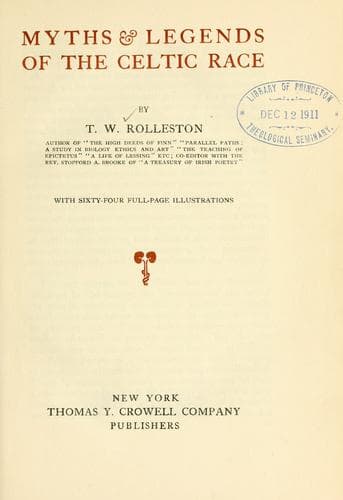
Myths & Legends of the Celtic RaceRolleston, T. W. (Thomas William)
Religion
Myths & Legends of the Celtic Race
Rolleston, T. W. (Thomas William)
Celts -- Religion; Mythology, Celtic
Then Maeldūn went to his own home and kindred, and Diuran the Rhymer took
with him the piece of silver that he had hewn from the net of the pillar,
and laid it on the high altar of Armagh in triumph and exultation at the
miracles that God had wrought for them. And they told again the story of
all that had befallen them, and all the marvels they had seen by sea and
land, and the perils they had endured.
The story ends with the following words:
“Now Aed the Fair [Aed Finn(204)], chief sage of Ireland, arranged this
story as it standeth here; and he did so for a delight to the mind, and
for the folks of Ireland after him.”
CHAPTER VIII: MYTHS AND TALES OF THE CYMRY
*Bardic Philosophy*
The absence in early Celtic literature of any world-myth, or any
philosophic account of the origin and constitution of things, was noticed
at the opening of our third chapter. In Gaelic literature there is, as far
as I know, nothing which even pretends to represent early Celtic thought
on this subject. It is otherwise in Wales. Here there has existed for a
considerable time a body of teaching purporting to contain a portion, at
any rate, of that ancient Druidic thought which, as Caesar tells us, was
communicated only to the initiated, and never written down. This teaching
is principally to be found in two volumes entitled “Barddas,” a
compilation made from materials in his possession by a Welsh bard and
scholar named Llewellyn Sion, of Glamorgan, towards the end of the
sixteenth century, and edited, with a translation, by J.A. Williams ap
Ithel for the Welsh MS. Society. Modern Celtic scholars pour contempt on
the pretensions of works like this to enshrine any really antique thought.
Thus Mr. Ivor B. John: “All idea of a bardic esoteric doctrine involving
pre-Christian mythic philosophy must be utterly discarded.” And again:
“The nonsense talked upon the subject is largely due to the uncritical
invention of pseudo-antiquaries of the sixteenth to seventeenth and
eighteenth centuries.”(205) Still the bardic Order was certainly at one
time in possession of such a doctrine. That Order had a fairly continuous
existence in Wales. And though no critical thinker would build with any
confidence a theory of pre-Christian doctrine on a document of the
sixteenth century, it does not seem wise to scout altogether the
possibility that some fragments of antique lore may have lingered even so
late as that in bardic tradition.
At any rate, “Barddas” is a work of considerable philosophic interest, and
even if it represents nothing but a certain current of Cymric thought in
the sixteenth century it is not unworthy of attention by the student of
things Celtic. Purely Druidic it does not even profess to be, for
Christian personages and episodes from Christian history figure largely in
it. But we come occasionally upon a strain of thought which, whatever else
it may be, is certainly not Christian, and speaks of an independent
philosophic system.
Public-domain text, read in full here on John Shaqi.
Reviews
Reviews
No reviews yet
Be the first to share your thoughts on this work.
Elsewhere in the archive
Join the Discussion
Join the discussion
Sign in to leave a comment or review.
Sign InorCreate an account