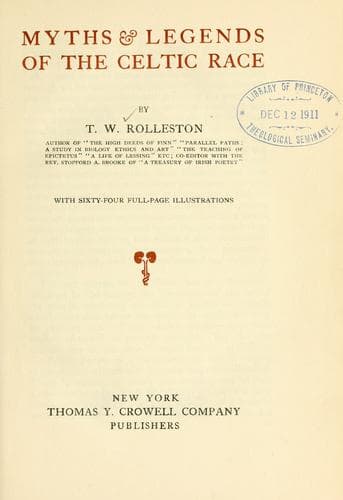
Myths & Legends of the Celtic RaceRolleston, T. W. (Thomas William)
Religion
Myths & Legends of the Celtic Race
Rolleston, T. W. (Thomas William)
Celts -- Religion; Mythology, Celtic
Every being, we are told, shall attain to the circle of Gwynfyd at
last.(207)
There is much here that reminds us of Gnostic or Oriental thought. It is
certainly very unlike Christian orthodoxy of the sixteenth century. As a
product of the Cymric mind of that period the reader may take it for what
it is worth, without troubling himself either with antiquarian theories or
with their refutations.
Let us now turn to the really ancient work, which is not philosophic, but
creative and imaginative, produced by British bards and fabulists of the
Middle Ages. But before we go on to set forth what we shall find in this
literature we must delay a moment to discuss one thing which we shall not.
*The Arthurian Saga*
For the majority of modern readers who have not made any special study of
the subject, the mention of early British legend will inevitably call up
the glories of the Arthurian Saga—they will think of the fabled palace at
Caerleon-on-Usk, the Knights of the Round Table riding forth on chivalrous
adventure, the Quest of the Grail, the guilty love of Lancelot, flower of
knighthood, for the queen, the last great battle by the northern sea, the
voyage of Arthur, sorely wounded, but immortal, to the mystic valley of
Avalon. But as a matter of fact they will find in the native literature of
mediæval Wales little or nothing of all this—no Round Table, no Lancelot,
no Grail-Quest, no Isle of Avalon, until the Welsh learned about them from
abroad; and though there was indeed an Arthur in this literature, he is a
wholly different being from the Arthur of what we now call the Arthurian
Saga.
*Nennius*
The earliest extant mention of Arthur is to be found in the work of the
British historian Nennius, who wrote his “Historia Britonum” about the
year 800. He derives his authority from various sources—ancient monuments
and writings of Britain and of Ireland (in connexion with the latter
country he records the legend of Partholan), Roman annals, and chronicles
of saints, especially St. Germanus. He presents a fantastically Romanised
and Christianised view of British history, deriving the Britons from a
Trojan and Roman ancestry. His account of Arthur, however, is both sober
and brief. Arthur, who, according to Nennius, lived in the sixth century,
was not a king; his ancestry was less noble than that of many other
British chiefs, who, nevertheless, for his great talents as a military
_Imperator_, or _dux bellorum_, chose him for their leader against the
Saxons, whom he defeated in twelve battles, the last being at Mount Badon.
Arthur’s office was doubtless a relic of Roman military organisation, and
there is no reason to doubt his historical existence, however impenetrable
may be the veil which now obscures his valiant and often triumphant
battlings for order and civilisation in that disastrous age.
*Geoffrey of Monmouth*
Public-domain text, read in full here on John Shaqi.
Reviews
Reviews
No reviews yet
Be the first to share your thoughts on this work.
Elsewhere in the archive
Join the Discussion
Join the discussion
Sign in to leave a comment or review.
Sign InorCreate an account