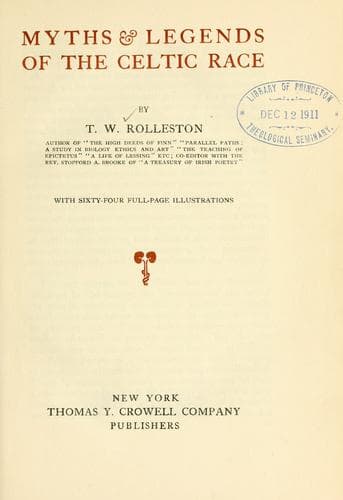
Myths & Legends of the Celtic RaceRolleston, T. W. (Thomas William)
Religion
Myths & Legends of the Celtic Race
Rolleston, T. W. (Thomas William)
Celts -- Religion; Mythology, Celtic
Next we have Geoffrey of Monmouth, Bishop of St. Asaph, who wrote his
“Historia Regum Britaniæ” in South Wales in the early part of the twelfth
century. This work is an audacious attempt to make sober history out of a
mass of mythical or legendary matter mainly derived, if we are to believe
the author, from an ancient book brought by his uncle Walter, Archdeacon
of Oxford, from Brittany. The mention of Brittany in this connexion is, as
we shall see, very significant. Geoffrey wrote expressly to commemorate
the exploits of Arthur, who now appears as a king, son of Uther Pendragon
and of Igerna, wife of Gorlois, Duke of Cornwall, to whom Uther gained
access in the shape of her husband through the magic arts of Merlin. He
places the beginning of Arthur’s reign in the year 505, recounts his wars
against the Saxons, and says he ultimately conquered not only all Britain,
but Ireland, Norway, Gaul, and Dacia, and successfully resisted a demand
for tribute and homage from the Romans. He held his court at
Caerleon-on-Usk. While he was away on the Continent carrying on his
struggle with Rome his nephew Modred usurped his crown and wedded his wife
Guanhumara. Arthur, on this, returned, and after defeating the traitor at
Winchester slew him in a last battle in Cornwall, where Arthur himself was
sorely wounded (A.D. 542). The queen retired to a convent at Caerleon.
Before his death Arthur conferred his kingdom on his kinsman Constantine,
and was then carried off mysteriously to “the isle of Avalon” to be cured,
and “the rest is silence.” Arthur’s magic sword “Caliburn” (Welsh
_Caladvwlch_; see p. 224, note) is mentioned by Geoffrey and described as
having been made in Avalon, a word which seems to imply some kind of
fairyland, a Land of the Dead, and may be related to the Norse _Valhall_.
It was not until later times that Avalon came to be identified with an
actual site in Britain (Glastonbury). In Geoffrey’s narrative there is
nothing about the Holy Grail, or Lancelot, or the Round Table, and except
for the allusion to Avalon the mystical element of the Arthurian saga is
absent. Like Nennius, Geoffrey finds a fantastic classical origin for the
Britons. His so-called history is perfectly worthless as a record of fact,
but it has proved a veritable mine for poets and chroniclers, and has the
distinction of having furnished the subject for the earliest English
tragic drama, “Gorboduc,” as well as for Shakespeare’s “King Lear”; and
its author may be described as the father—at least on its quasi-historical
side—of the Arthurian saga, which he made up partly out of records of the
historical _dux bellorum_ of Nennius and partly out of poetical
amplifications of these records made in Brittany by the descendants of
exiles from Wales, many of whom fled there at the very time when Arthur
was waging his wars against the heathen Saxons. Geoffrey’s book had a
wonderful success. It was speedily translated into French by Wace, who
Public-domain text, read in full here on John Shaqi.
Reviews
Reviews
No reviews yet
Be the first to share your thoughts on this work.
Elsewhere in the archive
Join the Discussion
Join the discussion
Sign in to leave a comment or review.
Sign InorCreate an account