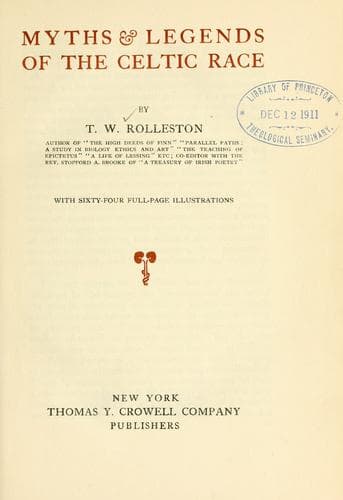
Myths & Legends of the Celtic RaceRolleston, T. W. (Thomas William)
Religion
Myths & Legends of the Celtic Race
Rolleston, T. W. (Thomas William)
Celts -- Religion; Mythology, Celtic
wrote “Li Romans de Brut” about 1155, with added details from Breton
sources, and translated from Wace’s French into Anglo-Saxon by Layamon,
who thus anticipated Malory’s adaptations of late French prose romances.
Except a few scholars who protested unavailingly, no one doubted its
strict historical truth, and it had the important effect of giving to
early British history a new dignity in the estimation of Continental and
of English princes. To sit upon the throne of Arthur was regarded as in
itself a glory by Plantagenet monarchs who had not a trace of Arthur’s or
of any British blood.
*The Saga in Brittany: Marie de France*
The Breton sources must next be considered. Unfortunately, not a line of
ancient Breton literature has come down to us, and for our knowledge of it
we must rely on the appearances it makes in the work of French writers.
One of the earliest of these is the Anglo-Norman poetess who called
herself Marie de France, and who wrote about 1150 and afterwards. She
wrote, among other things, a number of “Lais,” or tales, which she
explicitly and repeatedly tells us were translated or adapted from Breton
sources. Sometimes she claims to have rendered a writer’s original
exactly:
“Les contes que jo sai verais
Dunt li Bretun unt fait les lais
Vos conterai assez briefment;
Et cief [sauf] di cest coumencement
Selunc la lettre è l’escriture.”
Little is actually said about Arthur in these tales, but the events of
them are placed in his time—_en cel tems tint Artus la terre_—and the
allusions, which include a mention of the Round Table, evidently imply a
general knowledge of the subject among those to whom these Breton “Lais”
were addressed. Lancelot is not mentioned, but there is a “Lai” about one
Lanval, who is beloved by Arthur’s queen, but rejects her because he has a
fairy mistress in the “isle d’Avalon.” Gawain is mentioned, and an episode
is told in the “Lai de Chevrefoil” about Tristan and Iseult, whose maid,
“Brangien,” is referred to in a way which assumes that the audience knew
the part she had played on Iseult’s bridal night. In short, we have
evidence here of the existence in Brittany of a well-diffused and
well-developed body of chivalric legend gathered about the personality of
Arthur. The legends are so well known that mere allusions to characters
and episodes in them are as well understood as references to Tennyson’s
“Idylls” would be among us to-day. The “Lais” of Marie de France therefore
point strongly to Brittany as the true cradle of the Arthurian saga, on
its chivalrous and romantic side. They do not, however, mention the Grail.
*Chrestien de Troyes*
Public-domain text, read in full here on John Shaqi.
Reviews
Reviews
No reviews yet
Be the first to share your thoughts on this work.
Elsewhere in the archive
Join the Discussion
Join the discussion
Sign in to leave a comment or review.
Sign InorCreate an account