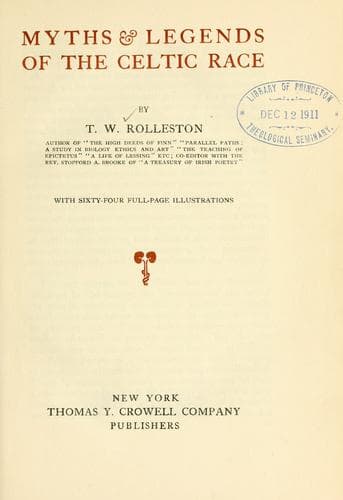
Myths & Legends of the Celtic RaceRolleston, T. W. (Thomas William)
Religion
Myths & Legends of the Celtic Race
Rolleston, T. W. (Thomas William)
Celts -- Religion; Mythology, Celtic
In the absence, however, of any information as to when, or exactly what,
Bleheris wrote, the opinion must, I think, hold the field that the
Arthurian saga, as we have it now, is not of Welsh, nor even of pure
Breton origin. The Welsh exiles who colonised part of Brittany about the
sixth century must have brought with them many stories of the historical
Arthur. They must also have brought legends of the Celtic deity Artaius, a
god to whom altars have been found in France. These personages ultimately
blended into one, even as in Ireland the Christian St. Brigit blended with
the pagan goddess Brigindo.(210) We thus get a mythical figure combining
something of the exaltation of a god with a definite habitation on earth
and a place in history. An Arthur saga thus arose, which in its Breton
(though not its Welsh) form was greatly enriched by material drawn in from
the legends of Charlemagne and his peers, while both in Brittany and in
Wales it became a centre round which clustered a mass of floating
legendary matter relating to various Celtic personages, human and divine.
Chrestien de Troyes, working on Breton material, ultimately gave it the
form in which it conquered the world, and in which it became in the
twelfth and the thirteenth centuries what the Faust legend was in later
times, the accepted vehicle for the ideals and aspirations of an epoch.
*The Saga in Wales*
From the Continent, and especially from Brittany, the story of Arthur came
back into Wales transformed and glorified. The late Dr. Heinrich Zimmer,
in one of his luminous studies of the subject, remarks that “In Welsh
literature we have definite evidence that the South-Welsh prince, Rhys ap
Tewdwr, who had been in Brittany, brought from thence in the year 1070 the
knowledge of Arthur’s Round Table to Wales, where of course it had been
hitherto unknown.”(211) And many Breton lords are known to have followed
the banner of William the Conqueror into England.(212) The introducers of
the saga into Wales found, however, a considerable body of Arthurian
matter of a very different character already in existence there. Besides
the traditions of the historical Arthur, the _dux bellorum_ of Nennius,
there was the Celtic deity, Artaius. It is probably a reminiscence of this
deity whom we meet with under the name of Arthur in the only genuine Welsh
Arthurian story we possess, the story of Kilhwch and Olwen in the
“Mabinogion.” Much of the Arthurian saga derived from Chrestien and other
Continental writers was translated and adapted in Wales as in other
European countries, but as a matter of fact it made a later and a lesser
impression in Wales than almost anywhere else. It conflicted with existing
Welsh traditions, both historical and mythological; it was full of matter
entirely foreign to the Welsh spirit, and it remained always in Wales
something alien and unassimilated. Into Ireland it never entered at all.
Public-domain text, read in full here on John Shaqi.
Reviews
Reviews
No reviews yet
Be the first to share your thoughts on this work.
Elsewhere in the archive
Join the Discussion
Join the discussion
Sign in to leave a comment or review.
Sign InorCreate an account