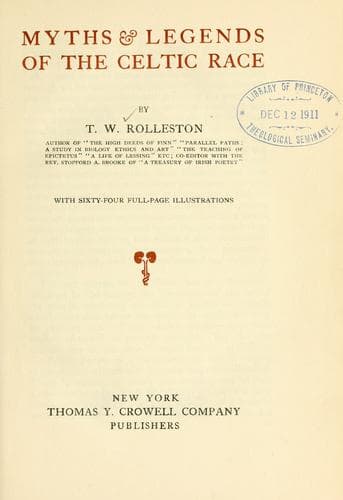
Myths & Legends of the Celtic RaceRolleston, T. W. (Thomas William)
Religion
Myths & Legends of the Celtic Race
Rolleston, T. W. (Thomas William)
Celts -- Religion; Mythology, Celtic
These few introductory remarks do not, of course, profess to contain a
discussion of the Arthurian saga—a vast subject with myriad ramifications,
historical, mythological, mystical, and what not—but are merely intended
to indicate the relation of that saga to genuine Celtic literature and to
explain why we shall hear so little of it in the following accounts of
Cymric myths and legends. It was a great spiritual myth which, arising
from the composite source above described, overran all the Continent, as
its hero was supposed to have done in armed conquest, but it cannot be
regarded as a special possession of the Celtic race, nor is it at present
extant, except in the form of translation or adaptation, in any Celtic
tongue.
*Gaelic and Cymric Legend Compared*
The myths and legends of the Celtic race which have come down to us in the
Welsh language are in some respects of a different character from those
which we possess in Gaelic. The Welsh material is nothing like as full as
the Gaelic, nor so early. The tales of the “Mabinogion” are mainly drawn
from the fourteenth-century manuscript entitled “The Red Book of Hergest.”
One of them, the romance of Taliesin, came from another source, a
manuscript of the seventeenth century. The four oldest tales in the
“Mabinogion” are supposed by scholars to have taken their present shape in
the tenth or eleventh century, while several Irish tales, like the story
of Etain and Midir or the Death of Conary, go back to the seventh or
eighth. It will be remembered that the story of the invasion of Partholan
was known to Nennius, who wrote about the year 800. As one might therefore
expect, the mythological elements in the Welsh romances are usually much
more confused and harder to decipher than in the earlier of the Irish
tales. The mythic interest has grown less, the story interest greater; the
object of the bard is less to hand down a sacred text than to entertain a
prince’s court. We must remember also that the influence of the
Continental romances of chivalry is clearly perceptible in the Welsh
tales; and, in fact, comes eventually to govern them completely.
*Gaelic and Continental Romance*
Public-domain text, read in full here on John Shaqi.
Reviews
Reviews
No reviews yet
Be the first to share your thoughts on this work.
Elsewhere in the archive
Join the Discussion
Join the discussion
Sign in to leave a comment or review.
Sign InorCreate an account