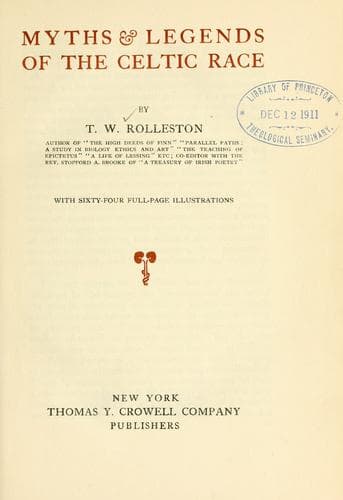
Myths & Legends of the Celtic RaceRolleston, T. W. (Thomas William)
Religion
Myths & Legends of the Celtic Race
Rolleston, T. W. (Thomas William)
Celts -- Religion; Mythology, Celtic
No human influences are ever found pure and unmixed. The sentiment of
personal fidelity was not unknown to the classical nations. The sentiment
of civic patriotism, though of slow growth among the Teutonic races, did
eventually establish itself there. Neither sentiment was unknown to the
Celt, but there was another force which, in his case, overshadowed and
dwarfed them, and supplied what it could of the political inspiration and
unifying power which the classical nations got from patriotism and the
Teutons from loyalty. This was Religion; or perhaps it would be more
accurate to say Sacerdotalism—religion codified in dogma and administered
by a priestly caste. The Druids, as we have seen from Cæsar, whose
observations are entirely confirmed by Strabo and by references in Irish
legends,(25) were the really sovran power in Celtica. All affairs, public
and private, were subject to their authority, and the penalties which they
could inflict for any assertion of lay independence, though resting for
their efficacy, like the mediæval interdicts of the Catholic Church, on
popular superstition alone, were enough to quell the proudest spirit. Here
lay the real weakness of the Celtic polity. There is perhaps no law
written more conspicuously in the teachings of history than that nations
who are ruled by priests drawing their authority from supernatural
sanctions are, just in the measure that they are so ruled, incapable of
true national progress. The free, healthy current of secular life and
thought is, in the very nature of things, incompatible with priestly rule.
Be the creed what it may, Druidism, Islam, Judaism, Christianity, or
fetichism, a priestly caste claiming authority in temporal affairs by
virtue of extra-temporal sanctions is inevitably the enemy of that spirit
of criticism, of that influx of new ideas, of that growth of secular
thought, of human and rational authority, which are the elementary
conditions of national development.
*The Cursing of Tara*
Public-domain text, read in full here on John Shaqi.
Reviews
Reviews
No reviews yet
Be the first to share your thoughts on this work.
Join the Discussion
Join the discussion
Sign in to leave a comment or review.
Sign InorCreate an account