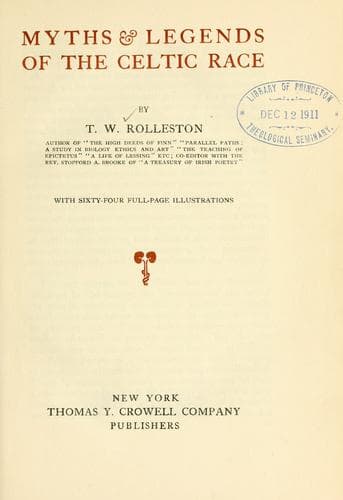
Myths & Legends of the Celtic RaceRolleston, T. W. (Thomas William)
Religion
Myths & Legends of the Celtic Race
Rolleston, T. W. (Thomas William)
Celts -- Religion; Mythology, Celtic
After the two historical chapters with which our study has begun, the
object of the book has been literary rather than scientific. I have,
however, endeavoured to give, as the opportunity arose, such results of
recent critical work on the relics of Celtic myth and legend as may at
least serve to indicate to the reader the nature of the critical problems
connected therewith. I hope that this may have added somewhat to the value
of the work for students, while not impairing its interest for the general
reader. Furthermore, I may claim that the book is in this sense
scientific, that as far as possible it avoids any adaptation of its
material for the popular taste. Such adaptation, when done for an avowed
artistic purpose, is of course entirely legitimate; if it were not, we
should have to condemn half the great poetry of the world. But here the
object has been to present the myths and legends of the Celt as they
actually are. Crudities have not been refined away, things painful or
monstrous have not been suppressed, except in some few instances, where it
has been necessary to bear in mind that this volume appeals to a wider
audience than that of scientific students alone. The reader may, I think,
rely upon it that he has here a substantially fair and not over-idealised
account of the Celtic outlook upon life and the world at a time when the
Celt still had a free, independent, natural life, working out his
conceptions in the Celtic tongue, and taking no more from foreign sources
than he could assimilate and make his own. The legendary literature thus
presented is the oldest non-classical literature of Europe. This alone is
sufficient, I think, to give it a strong claim on our attention. As to
what other claims it may have, many pages might be filled with quotations
from the discerning praises given to it by critics not of Celtic
nationality, from Matthew Arnold downwards. But here let it speak for
itself. It will tell us, I believe, that, as Maeldūn said of one of the
marvels he met with in his voyage into Fairyland: “What we see here was a
work of mighty men.”
GLOSSARY AND INDEX
THE PRONUNCIATION OF CELTIC NAMES
To render these names accurately without the living voice is impossible.
But with the phonetic renderings given, where required, in the following
index, and with attention to the following general rules, the reader will
get as near to the correct pronunciation as it is at all necessary for him
to do.
I. GAELIC
Vowels are pronounced as in French or German; thus _i_ (long) is like _ee,
e_ (long) like _a_ in “date,” _u_ (long) like _oo_. A stroke over a letter
signifies length; thus dūn is pronounced “doon” (not “dewn”).
_ch_ is a guttural, as in the word “loch.” It is never pronounced with a
_t_ sound, as in English “chip.”
_c_ is always like _k_.
_gh_ is silent, as in English.
II. CYMRIC
Public-domain text, read in full here on John Shaqi.
Reviews
Reviews
No reviews yet
Be the first to share your thoughts on this work.
Elsewhere in the archive
Join the Discussion
Join the discussion
Sign in to leave a comment or review.
Sign InorCreate an account