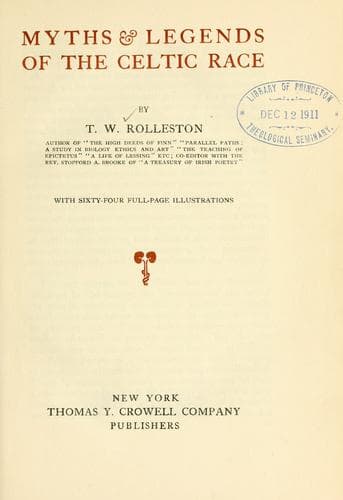
Myths & Legends of the Celtic RaceRolleston, T. W. (Thomas William)
Religion
Myths & Legends of the Celtic Race
Rolleston, T. W. (Thomas William)
Celts -- Religion; Mythology, Celtic
The culture of these mountain Celts differed markedly from that of the
lowlanders. Their age was the age of iron, not of bronze; their dead were
not burned (which they considered a disgrace), but buried.
The territories occupied by them in force were Switzerland, Burgundy, the
Palatinate, and Northern France, parts of Britain to the west, and Illyria
and Galatia to the east, but smaller groups of them must have penetrated
far and wide through all Celtic territory, and taken up a ruling position
wherever they went.
[Stone Alignments at Kermaris, Carnac]
Stone Alignments at Kermaris, Carnac
Arthur G. Bell
There were three peoples, said Cæsar, inhabiting Gaul when his conquest
began; “they differ from each other in language, in customs, and in laws.”
These people he named respectively the Belgæ, the Celtæ, and the Aquitani.
He locates them roughly, the Belgæ in the north and east, the Celtæ in the
middle, and the Aquitani in the west and south. The Belgæ are the Galatæ
of Bertrand, the Celtæ are the Celts, and the Aquitani are the Megalithic
People. They had, of course, all been more or less brought under Celtic
influences, and the differences of language which Cæsar noticed need not
have been great; still it is noteworthy, and quite in accordance with
Bertrand’s views, that Strabo speaks of the Aquitani as differing markedly
from the rest of the inhabitants, and as resembling the Iberians. The
language of the other Gaulish peoples, he expressly adds, were merely
dialects of the same tongue.
*The Religion of Magic*
This triple division is reflected more or less in all the Celtic
countries, and must always be borne in mind when we speak of Celtic ideas
and Celtic religion, and try to estimate the contribution of the Celtic
peoples to European culture. The mythical literature and the art of the
Celt have probably sprung mainly from the section represented by the
Lowland Celts of Bertrand. But this literature of song and saga was
produced by a bardic class for the pleasure and instruction of a proud,
chivalrous, and warlike aristocracy, and would thus inevitably be moulded
by the ideas of this aristocracy. But it would also have been coloured by
the profound influence of the religious beliefs and observances
entertained by the Megalithic People—beliefs which are only now fading
slowly away in the spreading daylight of science. These beliefs may be
summed up in the one term Magic. The nature of this religion of magic must
now be briefly discussed, for it was a potent element in the formation of
the body of myths and legends with which we have afterwards to deal. And,
as Professor Bury remarked in his Inaugural Lecture at Cambridge, in 1903:
Public-domain text, read in full here on John Shaqi.
Reviews
Reviews
No reviews yet
Be the first to share your thoughts on this work.
Join the Discussion
Join the discussion
Sign in to leave a comment or review.
Sign InorCreate an account