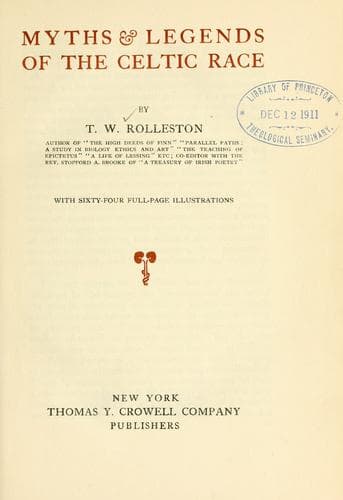
Myths & Legends of the Celtic RaceRolleston, T. W. (Thomas William)
Religion
Myths & Legends of the Celtic Race
Rolleston, T. W. (Thomas William)
Celts -- Religion; Mythology, Celtic
27 It was the practice, known in India also, for a person who was
wronged by a superior, or thought himself so, to sit before the
doorstep of the denier of justice and fast until right was done him.
In Ireland a magical power was attributed to the ceremony, the
effect of which would be averted by the other person fasting as
well.
28 “Silva Gadelica,” by S.H. O’Grady, p. 73.
29 The authority here quoted is a narrative contained in a
fifteenth-century vellum manuscript found in Lismore Castle in 1814,
and translated by S.H. O’Grady in his “Silva Gadelica.” The
narrative is attributed to an officer of Dermot’s court.
30 From Greek _megas_, great, and _lithos_, a stone.
31 See p. 78.
32 See Borlase’s “Dolmens of Ireland,” pp. 605, 606, for a discussion
of this question.
33 Professor Ridgeway (see Report of the Brit. Assoc. for 1908) has
contended that the Megalithic People spoke an Aryan language;
otherwise he thinks more traces of its influence must have survived
in the Celtic which supplanted it. The weight of authority, as well
as such direct evidence as we possess, seems to be against his view.
34 See Holder,“Altceltischer Sprachschatz.” _sulb voce_ “Hyperboreoi.”
35 Thus the Greek _pharmakon_=medicine, poison, or charm; and I am
informed that the Central African word for magic or charm is
_mankwala_, which also means medicine.
36 If Pliny meant that it was here first codified and organised he may
be right, but the conceptions on which magic rest are practically
universal, and of immemorial antiquity.
37 Adopted 451 B.C. Livy entitles them “the fountain of all public and
private right.” They stood in the Forum till the third century A.D.,
but have now perished, except for fragments preserved in various
commentaries.
38 See “Revue Archeologique,” t. xii., 1865, “Fouilles de René Galles.”
39 Jade is not found in the native state in Europe, nor nearer than
China.
40 Small stones, crystals, and gems were, however, also venerated. The
celebrated Black Stone of Pergamos was the subject of an embassy
from Rome to that city in the time of the Second Punic War, the
Sibylline Books having predicted victory to its possessors. It was
brought to Rome with great rejoicings in the year 205. It is stated
to have been about the size of a man’s fist, and was probably a
meteorite. Compare the myth in Hesiod which relates how Kronos
devoured a stone in the belief that it was his offspring, Zeus. It
was then possible to mistake a stone for a god.
41 Replaced by a photograph in this edition.
42 See Sir J. Simpson’s “Archaic Sculpturings” 1867.
43 The fact is recorded in the “Annals of the Four Masters” Under the
date 861, and in the “Annals of Ulster” under 862.
Public-domain text, read in full here on John Shaqi.
Reviews
Reviews
No reviews yet
Be the first to share your thoughts on this work.
Elsewhere in the archive
Join the Discussion
Join the discussion
Sign in to leave a comment or review.
Sign InorCreate an account