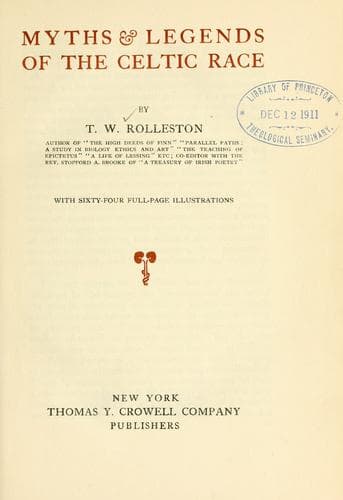
Myths & Legends of the Celtic RaceRolleston, T. W. (Thomas William)
Religion
Myths & Legends of the Celtic Race
Rolleston, T. W. (Thomas William)
Celts -- Religion; Mythology, Celtic
67 “The Irish Mythological Cycle,” by d’Arbois de Jubainville, p. 6l.
The “Dinnsenchus” in question is an early Christian document. No
trace of a being like Crom Cruach has been found as yet in the pagan
literature of Ireland, nor in the writings of St. Patrick, and I
think it is quite probable that even in the time of St. Patrick
human sacrifices had become only a memory.
68 A representation of human sacrifice has, however, lately been
discovered in a Temple of the Sun in the ancient Ethiopian capital,
Meroë.
69 “You [Celts] who by cruel blood outpoured think to appease the
pitiless Teutates, the horrid Æsus with his barbarous altars, and
Taranus whose worship is no gentler than that of the Scythian
Diana”, to whom captive were offered up. (Lucan, “Pharsalia”, i.
444.) An altar dedicated to Æsus has been discovered in Paris.
70 Mont Mercure, Mercœur, Mercoirey, Montmartre (_Mons Mercurii_), &c.
71 To this day in many parts of France the peasantry use terms like
_annuit, o’né, anneue_, &c., all meaning “to-night,” for
_aujourd’hui_ (Bertrand, “Rel. des G.,” p. 356).
72 The _fili_, or professional poets, it must be remembered, were a
branch of the Druidic order.
73 For instance, Pelagius in the fifth century; Columba, Columbanus,
and St. Gall in the sixth; Fridolin, named _Viator_, “the
Traveller,” and Fursa in the seventh; Virgilius (Feargal) of
Salzburg, who had to answer at Rome for teaching the sphericity of
the earth, in the eighth; Dicuil, “the Geographer,” and Johannes
Scotus Erigena—the master mind of his epoch—in the ninth.
74 Dealgnaid. I have been obliged here, as occasionally elsewhere, to
modify the Irish names so as to make them pronounceable by English
readers.
75 See p. 48, _note_ 1.
76 I follow in this narrative R.I. Best’s translation of the “Irish
Mythological Cycle” of d’Arbois de Jubainville.
77 De Jubainville, “Irish Mythological Cycle,” p. 75.
78 Pronounced “Yeo´hee.” See Glossary for this and other words.
79 The science of the Druids, as we have seen, was conveyed in verse,
and the professional poets were a branch of the Druidic Order.
80 Meyer and Nutt, “Voyage of Bran,” ii. 197.
81 “Moytura” means “The Plain of the Towers”—_i.e._, sepulchral
monuments.
82 Shakespeare alludes to this in “As You Like It.” “I never was so
be-rhymed,” says Rosalind, “since Pythagoras’ time, that I was an
Irish rat—which I can hardly remember.”
83 Lyons, Leyden, Laon were all in ancient times known as _Lug-dunum,_
the Fortress of Lugh. _Luguvallum_ was the name of a town near
Hadrian’s Wall in Roman Britain.
84 It is given by him in a note to the “Four Masters,” vol. i. p. 18,
and is also reproduced by de Jubainville.
Public-domain text, read in full here on John Shaqi.
Reviews
Reviews
No reviews yet
Be the first to share your thoughts on this work.
Elsewhere in the archive
Join the Discussion
Join the discussion
Sign in to leave a comment or review.
Sign InorCreate an account