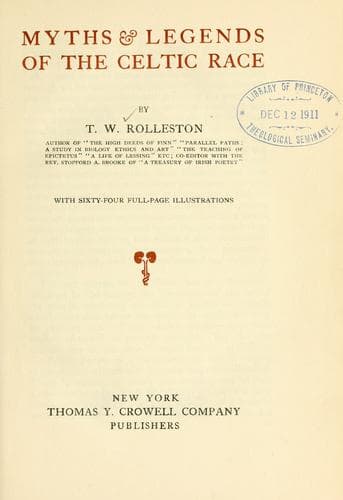
Myths & Legends of the Celtic RaceRolleston, T. W. (Thomas William)
Religion
Myths & Legends of the Celtic Race
Rolleston, T. W. (Thomas William)
Celts -- Religion; Mythology, Celtic
85 The other two were “The Fate of the Children of Lir” and “The Fate
of the Sons of Usna.” The stories of the Quest of the Sons of Turenn
and that of the Children of Lir have been told in full by the author
in his “High Deeds of Finn and other Bardic Romances,” and that of
the “Sons of Usna” (the Deirdre Legend) by Miss Eleanor Hull in her
“Cuchulain,” both published by Harrap and Co
86 O’Curry’s translation from the bardic tale, “The Battle of Moytura.”
87 O’Curry, “Manners and Customs,” iii. 214.
88 The ancient Irish division of the year contained only these three
seasons, including autumn in summer (O’Curry, “Manners and Customs,”
iii. 217).]
89 S.H. O’Grady, “Silva Gadelica,” p. 191.
90 Pp. 104 _sqq._, and _passim_.
91 O’Grady, _loc. cit._
92 O’Grady, _loc. cit._
93 See p. 112.
94 Miss Hull has discussed this subject fully in the introduction to
her invaluable work, “The Cuchullin Saga.”
95 See the tale of “Etain and Midir,” in Chap. IV.
96 The name Tara is derived from an oblique case of the nominative
_Teamhair_, meaning “the place of the wide prospect.” It is now a
broad grassy hill, in Co. Meath, covered with earthworks
representing the sites of the ancient royal buildings, which can all
be clearly located from ancient descriptions.
97 A.H. Leahy, “Heroic Romances,” i. 27.
98 See p. 114.
99 I cannot agree with Mr. O’Grady’s identification of this goddess
with Dana, though the name appears to mean “The Great Queen.”
100 Gerald, the fourth Earl of Desmond. He disappeared, it is said, in
1398, and the legend goes that he still lives beneath the waters of
Loch Gur, and may be seen riding round its banks on his white steed
once every seven years. He was surnamed “Gerald the Poet” from the
“witty and ingenious” verses he composed in Gaelic. Wizardry,
poetry, and science were all united in one conception in the mind of
the ancient Irish.
101 “Popular Tales of Ireland,” by D. Fitzgerald, in “Revue Celtique,”
vol. iv.
102 “The Voyage of Bran,” vol. ii. p. 219.
103 In Irish, _Sionnain_.
104 Translation by R.I. Best.
105 The solar vessels found in dolmen carvings. See Chap. II. p. 71
_sqq_. Note that the Celtic spirits, though invisible, are material
and have weight; not so those in Vergil and Dante.
106 De Jubainville, “Irish Mythological Cycle,” p. 136. Beltené is the
modern Irish name for the month of May, and is derived from an
ancient root preserved in the Old Irish compound _epelta_, “dead.”
107 “Irish Mythological Cycle,” p. 138.
108 I follow again de Jubainville’s translation; but in connexion with
this and the previous poems see also Ossianic Society’s
“Transactions,” vol. v.
109 Teltin; so named after the goddess Telta. See p. 103.
Public-domain text, read in full here on John Shaqi.
Reviews
Reviews
No reviews yet
Be the first to share your thoughts on this work.
Elsewhere in the archive
Join the Discussion
Join the discussion
Sign in to leave a comment or review.
Sign InorCreate an account