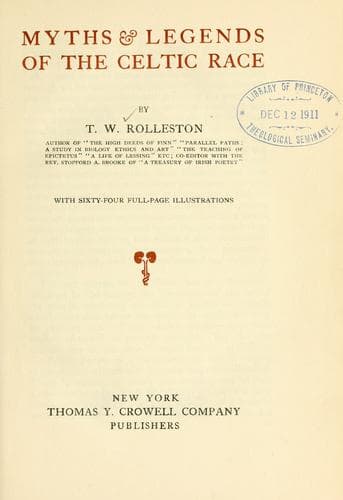
Myths & Legends of the Celtic RaceRolleston, T. W. (Thomas William)
Religion
Myths & Legends of the Celtic Race
Rolleston, T. W. (Thomas William)
Celts -- Religion; Mythology, Celtic
“Magic is one of the few things which it is important to discuss
at some length, were it only because, being the most delusive of
all the arts, it has everywhere and at all times been most
powerfully credited. Nor need it surprise us that it has obtained
so vast an influence, for it has united in itself the three arts
which have wielded the most powerful sway over the spirit of man.
Springing in the first instance from Medicine—a fact which no one
can doubt—and under cover of a solicitude for our health, it has
glided into the mind, and taken the form of another medicine, more
holy and more profound. In the second place, bearing the most
seductive and flattering promises, it has enlisted the motive of
Religion, the subject on which, even at this day, mankind is most
in the dark. To crown all it has had recourse to the art of
Astrology; and every man is eager to know the future and convinced
that this knowledge is most certainly to be obtained from the
heavens. Thus, holding the minds of men enchained in this triple
bond, it has extended its sway over many nations, and the Kings of
Kings obey it in the East.
“In the East, doubtless, it was invented—in Persia and by Zoroaster.(36)
All the authorities agree in this. But has there not been more than one
Zoroaster?... I have noticed that in ancient times, and indeed almost
always, one finds men seeking in this science the climax of literary
glory—at least Pythagoras, Empedocles, Democritus, and Plato crossed the
seas, exiles, in truth, rather than travellers, to instruct themselves in
this. Returning to their native land, they vaunted the claims of magic and
maintained its secret doctrine.... In the Latin nations there are early
traces of it, as, for instance, in our Laws of the Twelve Tables(37) and
other monuments, as I have said in a former book. In fact, it was not
until the year 657 after the foundation of Rome, under the consulate of
Cornelius Lentulus Crassus, that it was forbidden by a _senatus consultum_
to sacrifice human beings; a fact which proves that up to this date these
horrible sacrifices were made. The Gauls have been captivated by it, and
that even down to our own times, for it was the Emperor Tiberius who
suppressed the Druids and all the herd of prophets and medicine-men. But
what is the use of launching prohibitions against an art which has thus
traversed the ocean and penetrated even to the confines of Nature?”
(_Hist. Nat._ xxx.)
Pliny adds that the first person whom he can ascertain to have written on
this subject was Osthanes, who accompanied Xerxes in his war against the
Greeks, and who propagated the “germs of his monstrous art” wherever he
went in Europe.
Public-domain text, read in full here on John Shaqi.
Reviews
Reviews
No reviews yet
Be the first to share your thoughts on this work.
Join the Discussion
Join the discussion
Sign in to leave a comment or review.
Sign InorCreate an account