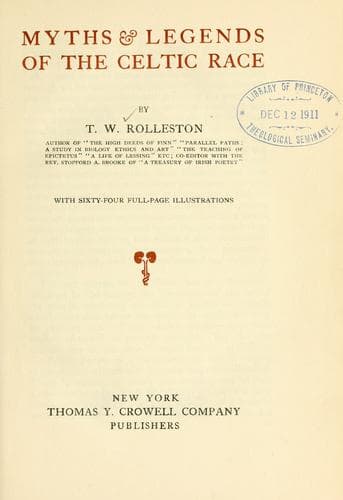
Myths & Legends of the Celtic RaceRolleston, T. W. (Thomas William)
Religion
Myths & Legends of the Celtic Race
Rolleston, T. W. (Thomas William)
Celts -- Religion; Mythology, Celtic
However it may have been conceived, it is certain that the belief in
immortality was the basis of Celtic Druidism.(63) Caesar affirms this
distinctly, and declares the doctrine to have been fostered by the Druids
rather for the promotion of courage than for purely religious reasons. An
intense Other-world faith, such as that held by the Celts, is certainly
one of the mightiest of agencies in the hands of a priesthood who hold the
keys of that world. Now Druidism existed in the British Islands, in Gaul,
and, in fact, so far as we know, wherever there was a Celtic race amid a
population of dolmen-builders. There were Celts in Cisalpine Gaul, but
there were no dolmens there, and there were no Druids.(64) What is quite
clear is that when the Celts got to Western Europe they found there a
people with a powerful priesthood, a ritual, and imposing religious
monuments; a people steeped in magic and mysticism and the cult of the
Underworld. The inferences, as I read the facts, seem to be that Druidism
in its essential features was imposed upon the imaginative and sensitive
nature of the Celt—the Celt with his “extraordinary aptitude” for picking
up ideas—by the earlier population of Western Europe, the Megalithic
People, while, as held by these, it stands in some historical relation,
which I am not able to pursue in further detail, with the religious
culture of ancient Egypt. Much obscurity still broods over the question,
and perhaps will always do so, but if these suggestions have anything in
them, then the Megalithic People have been brought a step or two out of
the atmosphere of uncanny mystery which has surrounded them, and they are
shown to have played a very important part in the religious development of
Western Europe, and in preparing that part of the world for the rapid
extension of the special type of Christianity which took place in it.
Bertrand, in his most interesting chapter on “L’Irlande Celtique,”(65)
points out that very soon after the conversion of Ireland to Christianity,
we find the country covered with monasteries, whose complete organisation
seems to indicate that they were really Druidic colleges transformed _en
masse_. Cæsar has told us what these colleges were like in Gaul. They were
very numerous. In spite of the severe study and discipline involved,
crowds flocked into them for the sake of the power wielded by the Druidic
order, and the civil immunities which its members of all grades enjoyed.
Arts and sciences were studied there, and thousands of verses enshrining
the teachings of Druidism were committed to memory. All this is very like
what we know of Irish Druidism. Such an organisation would pass into
Christianity of the type established in Ireland with very little
difficulty. The belief in magical rites would survive—early Irish
Christianity, as its copious hagiography plainly shows, was as steeped in
magical ideas as ever was Druidic paganism. The belief in immortality
Public-domain text, read in full here on John Shaqi.
Reviews
Reviews
No reviews yet
Be the first to share your thoughts on this work.
Join the Discussion
Join the discussion
Sign in to leave a comment or review.
Sign InorCreate an account