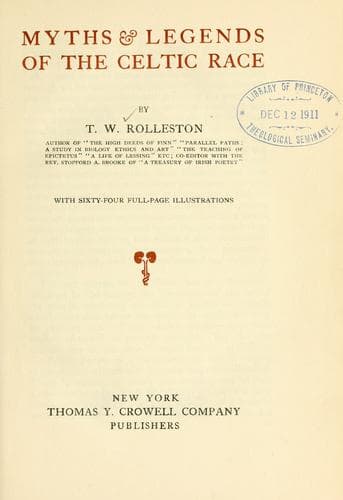
Myths & Legends of the Celtic RaceRolleston, T. W. (Thomas William)
Religion
Myths & Legends of the Celtic Race
Rolleston, T. W. (Thomas William)
Celts -- Religion; Mythology, Celtic
This wild tale, with its atmosphere of grey antiquity and of childlike
wonder, reminds us of the transformations of the Welsh Taliessin, who also
became an eagle, and points to that doctrine of the transmigration of the
soul which, as we have seen, haunted the imagination of the Celt.
We have now to add some details to the sketch of the successive
colonisations of Ireland outlined by Tuan mac Carell.
*The Nemedians*
The Nemedians, as we have seen, were akin to the Partholanians. Both of
them came from the mysterious regions of the dead, though later Irish
accounts, which endeavoured to reconcile this mythical matter with
Christianity, invented for them a descent from Scriptural patriarchs and
an origin in earthly lands such as Spain or Scythia. Both of them had to
do constant battle with the Fomorians, whom the later legends make out to
be pirates from oversea, but who are doubtless divinities representing the
powers of darkness and evil. There is no legend of the Fomorians coming
into Ireland, nor were they regarded as at any time a regular portion of
the population. They were coeval with the world itself. Nemed fought
victoriously against them in four great battles, but shortly afterwards
died of a plague which carried off 2000 of his people with him. The
Fomorians were then enabled to establish their tyranny over Ireland. They
had at this period two kings, Morc and Conann. The stronghold of the
Formorian power was on Tory Island, which uplifts its wild cliffs and
precipices in the Atlantic off the coast of Donegal—a fit home for this
race of mystery and horror. They extracted a crushing tribute from the
people of Ireland, two-thirds of all the milk and two-thirds of the
children of the land. At last the Nemedians rise in revolt. Led by three
chiefs, they land on Tory Island, capture Conann’s Tower, and Conann
himself falls by the hand of the Nemedian chief, Fergus. But Morc at this
moment comes into the battle with a fresh host, and utterly routs the
Nemedians, who are all slain but thirty:
“The men of Erin were all at the battle,
After the Fomorians came;
All of them the sea engulphed,
Save only three times ten.”
_Poem by Eochy O’Flann, circ_. A.D. 960.
The thirty survivors leave Ireland in despair. According to the most
ancient belief they perished utterly, leaving no descendants, but later
accounts, which endeavour to make sober history out of all these myths,
represent one family, that of the chief Britan, as settling in Great
Britain and giving their name to that country, while two others returned
to Ireland, after many wanderings, as the Firbolgs and People of Dana.
*The Coming of the Firbolgs*
Public-domain text, read in full here on John Shaqi.
Reviews
Reviews
No reviews yet
Be the first to share your thoughts on this work.
Elsewhere in the archive
Join the Discussion
Join the discussion
Sign in to leave a comment or review.
Sign InorCreate an account