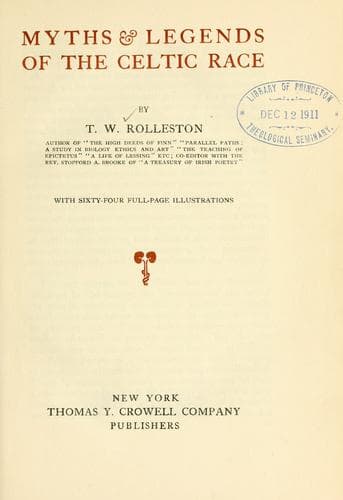
Myths & Legends of the Celtic RaceRolleston, T. W. (Thomas William)
Religion
Myths & Legends of the Celtic Race
Rolleston, T. W. (Thomas William)
Celts -- Religion; Mythology, Celtic
“On another St. John’s Night a number of girls had stayed late on the Hill
watching the _cliars_ (torches) and joining in the games. Suddenly Ainé
appeared among them, thanked them for the honour they had done her, but
said she now wished them to go home, as _they wanted the hill to
themselves_. She let them understand whom she meant by _they_, for calling
some of the girls she made them look through a ring, when behold, the hill
appeared crowded with people before invisible.”
“Here,” observed Mr. Alfred Nutt, “we have the antique ritual carried out
on a spot hallowed to one of the antique powers, watched over and shared
in by those powers themselves. Nowhere save in Gaeldom could be found such
a pregnant illustration of the identity of the fairy class with the
venerable powers to ensure whose goodwill rites and sacrifices, originally
fierce and bloody, now a mere simulacrum of their pristine form, have been
performed for countless ages.”(102)
*Sinend and the Well of Knowledge*
There is a singular myth which, while intended to account for the name of
the river Shannon, expresses the Celtic veneration for poetry and science,
combined with the warning that they may not be approached without danger.
The goddess Sinend, it was said, daughter of Lodan son of Lir, went to a
certain well named Connla’s Well, which is under the sea—_i.e._, in the
Land of Youth in Fairyland. “That is a well,” says the bardic narrative,
“at which are the hazels of wisdom and inspirations, that is, the hazels
of the science of poetry, and in the same hour their fruit and their
blossom and their foliage break forth, and then fall upon the well in the
same shower, which raises upon the water a royal surge of purple.” When
Sinend came to the well we are not told what rites or preparation she had
omitted, but the angry waters broke forth and overwhelmed her, and washed
her up on the Shannon shore, where she died, giving to the river its
name.(103) This myth of the hazels of inspiration and knowledge and their
association with springing water runs through all Irish legend, and has
been finely treated by a living Irish poet, Mr. G.W. Russell, in the
following verses:
“>A cabin on the mountain-side hid in a grassy nook,
With door and window open wide, where friendly stars may look;
The rabbit shy may patter in, the winds may enter free
Who roam around the mountain throne in living ecstasy.
“And when the sun sets dimmed in eve, and purple fills the air,
I think the sacred hazel-tree is dropping berries there,
From starry fruitage, waved aloft where Connla’s Well o’erflows;
For sure, the immortal waters run through every wind that blows.
“I think when Night towers up aloft and shakes the trembling dew,
How every high and lonely thought that thrills my spirit through
Is but a shining berry dropped down through the purple air,
And from the magic tree of life the fruit falls everywhere.”
*The Coming of the Milesians*
Public-domain text, read in full here on John Shaqi.
Reviews
Reviews
No reviews yet
Be the first to share your thoughts on this work.
Elsewhere in the archive
Join the Discussion
Join the discussion
Sign in to leave a comment or review.
Sign InorCreate an account